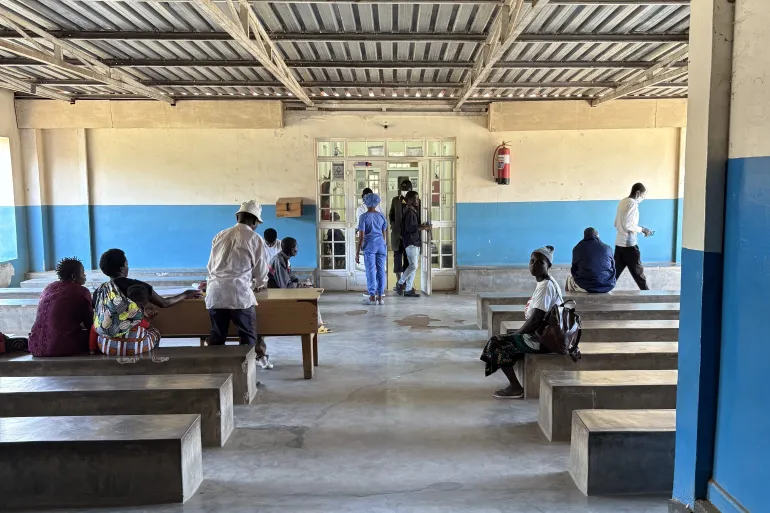
The USAID funding cuts Malawi now faces have triggered a deepening health crisis across remote communities. In Mulanje district, nurse Ireen Makata sits on a weathered bench outside a nearly empty health post. Once bustling with pregnant women, this clinic now opens only once every two weeks—its supplies stretched thin, its ambulance idle, and its staff rarely seen.
This post is one of 13 in the area, set up to bring basic care—antenatal visits, vaccines, family planning, and emergency transport—closer to seminomadic farming families. But since the Trump administration froze USAID programs in February, 20 such posts have already closed nationwide. The impact is immediate and severe.
Makata, a maternal and newborn care specialist, used to visit this site two or three times a week. Now, she comes rarely. “Most women find the distance to the district hospital too far,” she explains. The journey takes hours on bumpy dirt roads, pulling mothers away from farming, childcare, or income-generating work. Many simply go without care.
Consequently, women miss critical first-trimester antenatal visits. Others give birth on the road. “That puts baby and mother in jeopardy,” says Massive Matekenya, a local community leader. He recounts how a 40-year-old woman recently died from malaria—unable to reach help in time due to broken referral systems.
The root cause? The sudden halt of USAID’s MOMENTUM program. Before the cuts, the U.S. supplied nearly 32% of Malawi’s entire health budget. MOMENTUM alone funded 249 health posts across 14 districts, covering staff training, medicines, contraceptives, and even fuel for ambulances. Washington had committed $80 million to the effort.
Then, early this year, President Trump issued stop-work orders on foreign aid programs. Overnight, MOMENTUM shut down. Mobile clinics vanished. Medical trainees lost placements. Life-saving equipment vanished in rushed sales.
Although the UNFPA still supports some maternal health sites, its resources cannot fill the gap. Experts fear these remaining centers will run out of supplies within months.
Meanwhile, in Lilongwe, the crisis extends to fistula care. At the Bwaila Fistula Centre, coordinator Margaret Moyo treats women suffering from obstetric fistula—a childbirth injury causing incontinence and social stigma. The center sees over 400 patients yearly, many from rural areas or even Mozambique.
Moyo warns that reduced antenatal visits will lead to more undetected obstructed labors and rising fistula cases. “We must train more midwives and delay early pregnancies,” she insists, “but education and outreach are fading.”
Yet hope persists through grassroots efforts. Alefa Jeffrey, a fistula survivor, now serves as a community ambassador. After successful surgery, she launched a WhatsApp group and brought 39 women to the center. “Some have lived with fistula for years and think they’re beyond help,” she says. “But I am able to help them.”
The Malawian government also refuses to panic. Dr. Samson Mndolo, the country’s health secretary, recalls surviving earlier U.S. aid freezes in 2017. “We didn’t panic then, and we won’t now,” he says. Instead, they’re retooling the system: combining immunization trips with family planning, shifting to community-based care, and using digital tools like WhatsApp for remote consultations.
“We lost nearly 5,000 health workers overnight,” Mndolo admits. “But each crisis is an opportunity. This pushes us to build a stronger, more efficient system.”
Still, for mothers like 22-year-old Tendai Kausi in Mulanje, the reality feels dire. She brings her son to the shuttered post out of habit—but sees fewer women coming. “My child will be affected because services won’t get better,” she says. “I feel very sad for my community.”
Ultimately, the USAID funding cuts Malawi endures expose a painful truth: when foreign aid vanishes, it is the poorest mothers and children who pay the highest price.