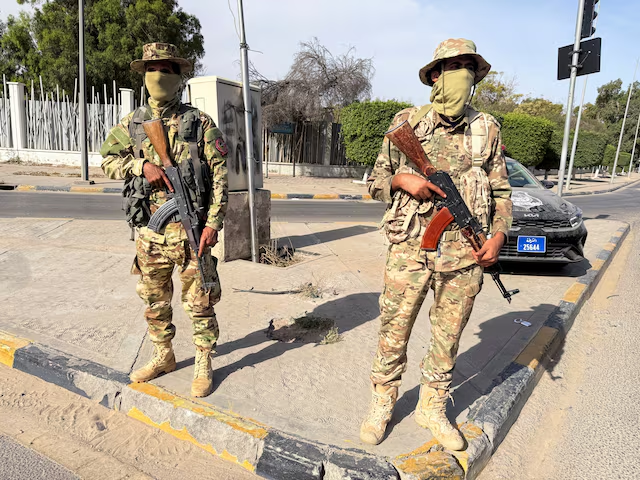
The worst fighting in Tripoli, Libya’s capital, in years calmed on Wednesday after a government-announced ceasefire. Tripoli residents reported relative peace, though authorities haven’t confirmed the number of casualties. The violence began late Monday after a militia leader was killed, sparking battles across the city.
By Tuesday morning, the fighting slowed, but it reignited overnight, with heavy battles spreading throughout Tripoli. The Libyan Defence Ministry deployed neutral units to sensitive areas to restore calm. These units, drawn from the police force, are unarmed and focused on de-escalating tensions.
The aftermath left burned cars on the streets and buildings scarred with bullet holes. Monday’s clashes seemed to strengthen Abdulhamid al-Dbeibah, prime minister of the Government of National Unity (GNU). However, prolonged fighting could escalate further, drawing in other factions.
The main conflict on Wednesday involved the Dbeibah-aligned 444 Brigade and the Special Deterrence Force (Rada), the last major faction in Tripoli not aligned with Dbeibah. Fighting also spread in the western parts of the city, a gateway for armed factions from Zawiya, a nearby town.
Dbeibah, on Tuesday, ordered the dismantling of irregular armed groups after the killing of Abdulghani Kikli (Ghaniwa). The defeat of his Stabilisation Support Apparatus (SSA) by Dbeibah’s factions shifted power in Tripoli, leaving Rada as the last major group not allied with the prime minister.
Terrifying for Residents
Residents, trapped in their homes by the fighting, shared their fear. One father in Dahra said, “It’s terrifying to witness all this intense fighting. I had my family in one room to avoid random shelling.” In Saraj, Mohanad Juma described the pause and restart of the fighting: “Each time it stops, we feel relieved. But then we lose hope again.”
The United Nations Libya Mission (UNSMIL) expressed alarm over the violence in Tripoli’s populated areas. They called for a ceasefire to protect civilians.
Libya has experienced instability since the 2011 NATO-backed uprising against Muammar Gaddafi. The country divided in 2014, with eastern and western factions. Major warfare paused after a 2020 truce. Khalifa Haftar, leader of the Libyan National Army (LNA), controls the east, while western Libya remains divided among armed factions.
Libya, a key energy exporter, has attracted foreign influence from Turkey, Russia, Egypt, and the United Arab Emirates. Despite the clashes, oil production remains unaffected. Key fields and export terminals are in the south and east. However, Sirte Oil Company, part of the National Oil Corporation (NOC), announced a suspension of land transport to the west until stability returns.