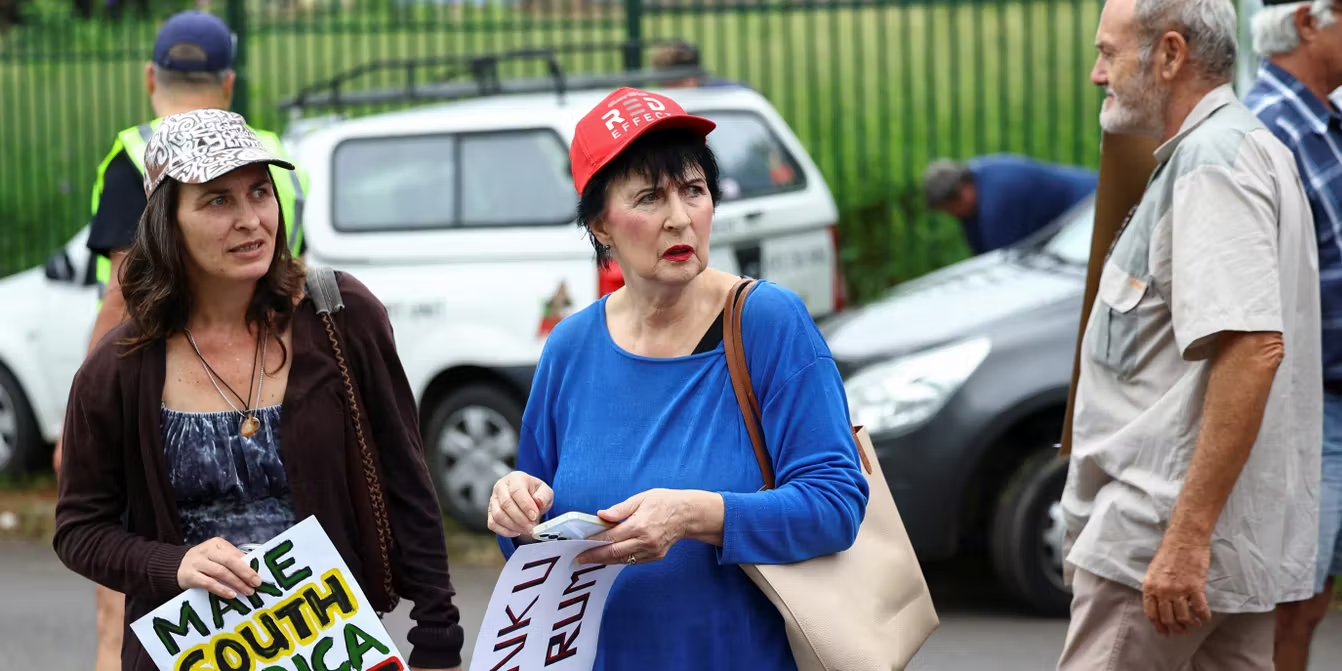
The White South Africa myth has become a powerful talking point in far-right politics, especially in the United States. It presents post-apartheid South Africa as a place where white people are under siege, facing persecution simply because Black citizens now hold political power. That narrative has gained traction in right-wing media, yet it distorts both South Africa’s past and its present.
In reality, the White South Africa myth ignores the deeper truth about apartheid and its legacy. It overlooks how authoritarian rule harmed not only Black South Africans, who bore the brunt of its brutality, but also many white citizens who lived under censorship, fear, forced military service and constant state control. The real lesson from South Africa is not that equality leads to revenge. It is that repressive systems wound entire societies.
White South Africa Myth Finds a Symbol in Orania
The White South Africa myth often centers on Orania, a small whites-only town in South Africa that has drawn global fascination for decades. Founded in 1991 as apartheid was collapsing, Orania was created by Afrikaners who feared the end of white-minority rule and wanted to preserve racial separation through private ownership rather than state law.
To many conservative commentators abroad, Orania became a symbol of white survival. They portrayed it as proof that white South Africans needed enclaves to protect themselves from a hostile Black-majority country. However, that interpretation says more about foreign racial anxieties than about life in South Africa itself.
The town’s appeal has long been exaggerated. Its existence has been used to support the White South Africa myth, even though it remains a tiny settlement rather than evidence of a nationwide collapse for white citizens.
How the White South Africa Myth Entered US Politics
The White South Africa myth gained new energy as American right-wing movements searched for global examples to support fears about racial change at home. South Africa was framed as a warning: once formerly oppressed people gain political influence, they will supposedly turn to revenge.
That message found a receptive audience among commentators who saw demographic and political change in the United States as a threat. South Africa was used as a supposed case study in what happens when white political dominance ends. Claims of a “white genocide” or systematic persecution were repeated in conservative media, despite lacking factual foundation.
When these claims entered mainstream political debate, the White South Africa myth moved from fringe rhetoric into policy arguments. It became a way to justify fear, exclusion and racial grievance far beyond South Africa.
The White South Africa Myth Ignores Economic and Social Reality
One reason the White South Africa myth persists is that it relies on emotion rather than evidence. It suggests that white South Africans have become helpless victims in the democratic era. Yet the broader reality is far more complex.
White South Africans, as a group, remain economically far better off than Black South Africans. They are not collectively stripped of power, property or safety because of their race. South Africa struggles with high crime, inequality and governance failures, but those problems affect the country broadly rather than functioning as a targeted anti-white campaign.
The White South Africa myth survives because it turns a deeply unequal society into a simple story of racial revenge. That version is easier for ideologues to sell, but it fails to reflect how most white South Africans actually live.
What Apartheid Did to White South Africans
The White South Africa myth also erases a difficult truth: apartheid itself damaged many white South Africans. It was designed to entrench white rule, but it did so through a police state that restricted speech, controlled culture, militarized society and filled daily life with fear.
White citizens lived under censorship, propaganda and surveillance. Many young white men were forced into military service and sent into violent conflict. Some suffered severe trauma, while others turned to alcohol, despair or silence. Families were shaped by authoritarian discipline and racial fear. Even those who benefited materially from apartheid often lived inside a deeply distorted society.
This part of the story is essential because it undermines the White South Africa myth. White life under apartheid was not simply secure and flourishing. It came with repression, psychological damage and a constant politics of fear.
Why the White South Africa Myth Misreads the Democratic Transition
The end of apartheid did not produce the mass racial revenge that many predicted. That matters because the White South Africa myth depends on the idea that Black political power would inevitably lead to anti-white violence and collapse.
Instead, South Africa’s democratic transition avoided the broad retaliatory bloodshed many had feared. White South Africans remained in the country in large numbers. Many found that life after apartheid, while still shaped by national problems, was more open and less suffocating than life under authoritarian white rule.
The White South Africa fails because it assumes domination is the only thing holding society together. South Africa’s actual history shows that even a deeply unequal country can move away from formal racial rule without descending into the apocalyptic future predicted by extremists.
Why the Myth Still Appeals to the Far Right
The South Africa myth remains attractive because it offers a political fantasy. It tells anxious white audiences that equality always becomes persecution and that power-sharing is just a prelude to revenge. That message can be used to justify harsher borders, stronger policing, attacks on diversity and suspicion toward democracy itself.
In this way, South Africa becomes less a real country than a symbolic warning in far-right storytelling. The myth is useful not because it is accurate, but because it supports broader ideological aims.
That is why the White South Africa myth continues to circulate. It gives fear a foreign example and turns a complicated nation into a simple political weapon.
The White South Africa has spread because it speaks to fear, resentment and racial anxiety, especially in countries wrestling with their own histories of inequality. Yet the myth falls apart when measured against South Africa’s real experience. White South Africans are not living through a race-based campaign of destruction. The country’s deepest wounds came from apartheid itself and from the repressive politics that upheld it.
The stronger lesson is clear. Police states and racial hierarchies do not truly protect the people they claim to serve. They poison public life, damage families and narrow the future for everyone. South Africa’s history does not prove that equality leads to revenge. It shows that freedom, however imperfect, is still a better path than rule built on fear.