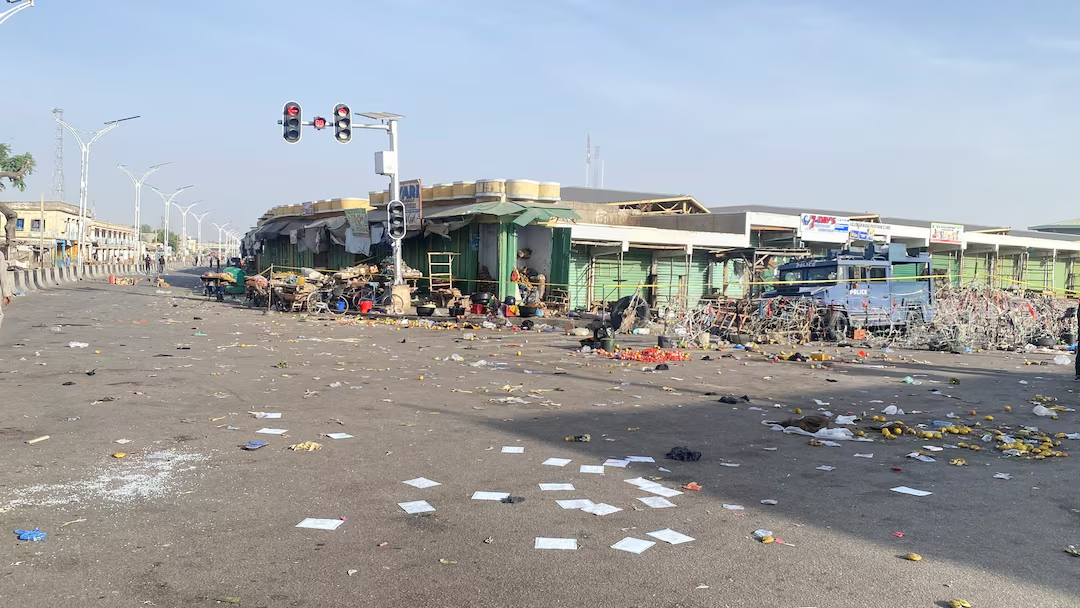
LONDON/LAGOS: Nigeria’s president described attacks in the northeast’s most heavily defended city as “the final desperate” acts of militants trying to spread fear. Many experts say the opposite is true. The blasts were a sign of strength not weakness. An assault on Maiduguri by coordinated suicide bombers points to state intelligence failures. It also shows the capacity of Islamist militants to hit urban areas despite waves of government operations against them, experts said.
It remains unclear which Nigerian militant groups carried out the attack. This uncertainty underscores the complexity of a sprawling 17-year insurgency. The conflict has killed tens of thousands of people and forced millions more from their homes. The latest attack demonstrates continuing Nigerian jihadist resilience despite sustained military pressure.
Analysts See Growing Confidence
Given a spate of other attacks in recent weeks carried out by both Boko Haram militants and ISWAP, an Islamic State-allied faction, some analysts said there could have been coordination between the often rival groups. “We have to see this as the groups oozing confidence in their ability to wreck terror in that part of the country,” said Ikemesit Effiong, partner at SBM Intelligence, a Nigeria-based risk advisory company.
“We think this is the start of a spate of bombings, not just in Maiduguri but also less protected urban areas in the northeast.” Effiong’s assessment challenges official narratives that militants are on the verge of defeat. The Nigerian jihadist resilience displayed in the coordinated attack suggests groups retain significant operational capability.
Government Response Pledged
President Bola Tinubu said on Tuesday he had approved additional equipment and support for the military. He promised the military would “completely defeat” the militants, repeating pledges made by previous administrations. Nigerian leaders have made similar commitments for years without achieving lasting success.
As violence has spread within Nigeria, including to the northwest, the US military has recently carried out air strikes and deployed military advisers. It was not immediately clear whether US troops would be involved in any response to the bombings. The international dimension adds complexity to an already difficult counterinsurgency campaign.
Waiting the Military Out
Nigeria has battled Islamist militants in the northeast since 2009. Boko Haram first emerged in Maiduguri, capital of Borno State, seeking to create an Islamic state. A violent crackdown led to the death of the group’s founder in police custody. The militants were driven out of urban areas at that time.
Since then, the group has splintered, spawning factions. One faction declared allegiance to Islamic State and has become the most powerful, administering swathes of northeastern Nigeria. ACLED, a crisis-monitoring group, said Monday’s attack was the deadliest suicide bombing in Nigeria for seven years.
Over the years, Nigerian military operations have not stopped Islamist groups from putting down roots, according to Vincent Foucher, senior research fellow with the National Centre for Scientific Research in Bordeaux. “The jihadists control substantial rural areas, the military hold towns which are entrenched,” he said.
Even when the military targets ISWAP strongholds, like they did recently in the Alagarno forest, Foucher said gains are often temporary. “They killed a few people, seized and destroyed some infrastructure, including an ISWAP prison. But the jihadists just move away and wait the military out,” he said. This adaptability underpins Nigerian jihadist resilience.
Nigeria’s military said it had foiled four attacks in separate locations outside Maiduguri ahead of Monday’s bombings. However, the success of the coordinated urban assault raises questions about overall effectiveness.
Intelligence Failures Identified
Malik Samuel, senior researcher at Good Governance Africa, said militant groups have the ability to strike anywhere in Borno state. However, carrying out three simultaneous attacks in a city hosting the military headquarters raised many questions. These include whether bombs were smuggled into the city or assembled there.
“It speaks to the intelligence failure and it shows that both factions are still very, very capable,” Samuel said. Samuel and two other experts believe Boko Haram militants carried out the attack itself. Boko Haram has a history of suicide bombings, whereas ISWAP has tended to avoid them. However, Effiong and two security sources did not rule out some degree of collaboration between them.
“Clearly, it means Maiduguri is not as safe as the authorities would want people to believe,” Samuel said. “Attacking Maiduguri is symbolic for these groups.” The symbolic value of striking the state capital and military headquarters cannot be overstated for groups seeking to demonstrate relevance.
Ramadan Escalation
Jihadists have escalated attacks on the Nigerian military during the Muslim holy month of Ramadan. They have killed dozens of troops, including senior officers, and seized equipment. On top of this, the attack in Maiduguri indicated that the militants were “not going anywhere, anytime soon,” Samuel said.
The timing during Ramadan carries religious significance for the groups. It also demonstrates operational planning that extends beyond immediate tactical considerations. The Nigerian jihadist resilience during a period of heightened religious observance suggests deep organizational commitment.
US Involvement and Limitations
The United States has had a long partnership with Nigeria’s military, providing training and selling weapons. It said it carried out air strikes in the northwest on Christmas Day to stop the targeting of Christians in the region. About 100 troops have since deployed to the country to support the military. The US military is providing intelligence from aerial surveillance.
One security source said this intelligence led to the destruction of four ISWAP gun trucks on March 11. But Effiong said it also exposed the government to accusations of being a Western stooge, potentially fuelling recruitment among jihadis. Neither the State Department nor US Africa Command responded to requests for comment.
Foucher said the faction that had been hit by US Tomahawk missiles in December was still operational. This highlights the limitations of US military action. “They can regenerate easily,” Foucher said. “There are so many different fires that are burning throughout Nigeria now. It is whack-a-mole.”
Outlook for Insurgency
The combination of multiple militant factions, vast ungoverned spaces, and limited state capacity suggests the insurgency will persist. Nigerian forces hold towns but cannot control rural areas. Militants move freely through large territories, planning operations at will.
The Nigerian jihadist resilience demonstrated in the Maiduguri attack will likely encourage further violence. Other militant cells may see the operation as proof that urban targets remain vulnerable. The government faces the challenge of protecting cities while also securing borders and rural areas. Resources are finite, and the insurgents have time on their side. As one analyst noted, they simply wait out military operations before returning to continue their campaign.