An IS-linked Congo attack has killed at least 66 civilians in eastern Democratic Republic of Congo, according to local officials and United Nations sources. The deadly assault targeted villages in Irumu territory, near the Uganda border, renewing fears about civilian safety in a region already battered by years of insurgent violence.
Authorities say the attack was carried out by fighters from the Allied Democratic Forces, an armed group aligned with the Islamic State. Residents reported that the assault unfolded over two days, leaving entire communities in shock as bodies were discovered across the affected villages. The IS-linked Congo attack comes at a time when hopes of easing conflict in eastern Congo had been cautiously rising due to shifting dynamics in the separate M23 rebellion.
United Nations officials stationed in Ituri province described the killings as extreme and deliberate. Information gathered from civil society groups indicates that the number of victims continued to rise as search efforts expanded. Local leaders said women were among those killed, and many victims were attacked with machetes, pointing to the brutality of the raid.
IS-linked Congo attack follows intensified military operations
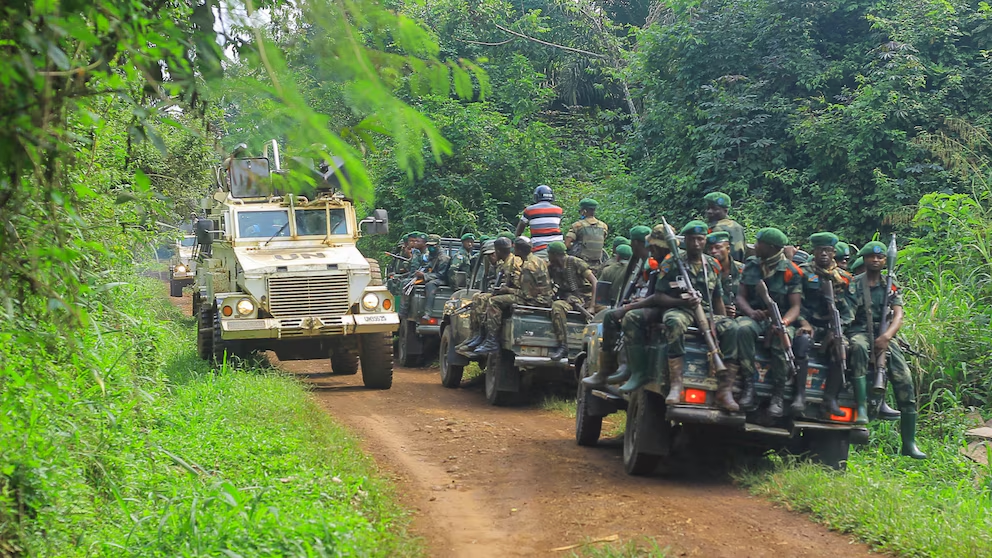
Security analysts believe the IS-linked Congo attack may be linked to recent joint operations by Congolese and Ugandan forces. Those operations have intensified in recent weeks, targeting militant hideouts along the porous border shared by the two countries.
The Allied Democratic Forces first emerged in Uganda in the late 1990s before relocating much of their operations into eastern Congo. In 2019, the group formally pledged allegiance to the Islamic State, a move that coincided with an increase in large-scale attacks on civilians. Since then, the group has become one of the most feared militant actors in the region.
Despite ongoing military pressure, the exact size of the ADF remains unclear. What is certain, however, is their continued ability to strike vulnerable communities with deadly precision.
Civilian suffering grows after IS-linked Congo attack
The IS-linked Congo attack highlights the persistent insecurity facing civilians in eastern Congo, where armed groups exploit weak governance and difficult terrain. Human rights organizations and the United Nations have repeatedly accused the ADF of mass killings, kidnappings, and forced recruitment, including the abduction of children.
Although Muslims account for a small share of Congo’s population, officials stress that the violence is driven by extremist ideology and armed conflict rather than religion itself. In recent years, ADF attacks have spread closer to major towns, raising alarm among humanitarian agencies and local authorities.
Previous incidents have followed a similar pattern, with villages raided and residents displaced after militants retreat into remote areas. As investigations into the latest IS-linked Congo attack continue, communities in Irumu are left mourning their dead and fearing what may come next.