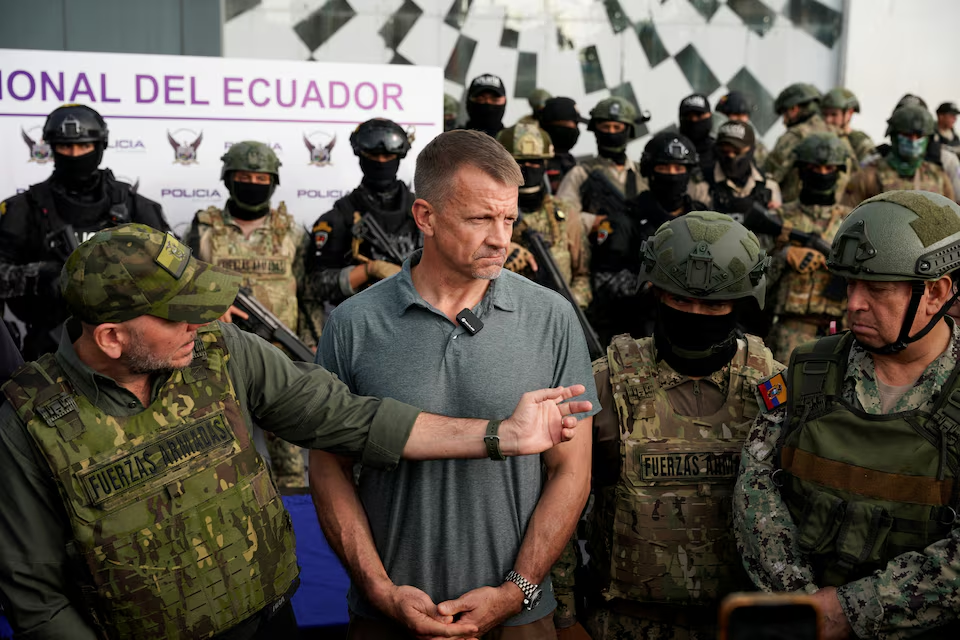
Blackwater founder Erik Prince deployed a private security force to operate drones and help Democratic Republic of Congo’s army secure the strategic city of Uvira against Rwanda-backed rebels, four people briefed on the mission said. The AFC/M23 rebels briefly seized the city on the border with Burundi in December. This was a major blow to ongoing U.S. and Qatar-backed peace negotiations. They withdrew after Washington threatened to retaliate. This Erik Prince Congo operation marks the first known involvement of his private security forces on the frontline in Congo. Consequently, it significantly widens his role in the decades-long conflict.
Prince, a supporter of President Donald Trump and founder of the now-defunct Blackwater, had been hired by the Kinshasa government. His primary contract was to help secure and improve tax revenue collection from Congo’s vast mineral reserves. However, the Uvira mission was a direct combat support operation. A senior Congolese security official stated the presence of U.S.-linked contractors would likely act as a deterrent to AFC/M23 forces. The official also said the operation is “in line with the minerals-for-security deal.” The U.S. has offered Congo support in brokering an end to the conflict in return for access to critical mineral resources. The State Department said it holds no contracts with Prince or his companies. A spokesperson for Prince declined to comment, and the Congolese presidency did not respond to queries.
Drone Support and Israeli Coordination
Sources said Prince’s contractors provided drone support to Congolese special operations forces and the army against M23 rebels in Uvira and the South Kivu highlands. Prince’s team deployed at Kinshasa’s request to bolster efforts at a critical time. The team has since withdrawn and returned to its primary revenue collection mission. However, another source indicated Prince’s team may continue to deploy to the frontline when requested by Kinshasa. Prince’s contractors operated in coordination with Israeli advisers involved in training two Congolese special forces battalions on day and night operations, according to a fifth source. One source emphasized the Israeli mandate is “training only.” The Israeli embassy in Luanda and the Israeli Foreign Ministry did not respond to requests for comment.
Strategic Context: Uvira and the Minerals-for-Security Deal
The operation occurred against the backdrop of a formal U.S.-DRC Strategic Partnership Agreement. The agreement, which entered implementation in February 2026, grants U.S. companies preferential access to Congolese Strategic Asset Reserve minerals in exchange for investment and support. While it is not clear whether the involvement of Prince on Congo’s frontlines was endorsed by Washington, the operation to help Kinshasa retake Uvira followed U.S. calls for the rebels to withdraw. In Congo, opposition to the mineral partnerships is growing. A group of lawyers and human rights activists has filed a lawsuit arguing the deal threatens Congo’s sovereignty. Archbishop Fulgence Muteba, president of the National Episcopal Conference of Congo, likened the strategic partnership to “selling off the minerals of an entire nation to save a regime or a political system.”
M23 Withdrawal and Ongoing Conflict
M23 rebels began withdrawing from Uvira on December 17, 2025, following U.S. pressure, M23 political leader Bertrand Bisimwa said the withdrawal was “under way” and would be complete within days. Corneille Nangaa, leader of the AFC coalition, stressed the withdrawal was “conditional” and urged security guarantees, including the deployment of a neutral force. The Congolese government expressed skepticism, with spokesman Patrick Muyaya calling for “vigilance” and stating the withdrawal needed verification. The Uvira offensive left dozens dead, at least 100 wounded, and more than 200,000 displaced, with at least 30,000 civilians fleeing into Burundi. Fighting continues elsewhere despite peace efforts.
Broader Conflict and Regional Dynamics
Fighting in the decades-long conflict flared early last year, with M23 fighters making rapid gains in the east, which is rich in tantalum, gold, lithium, cobalt, and coltan. The United Nations and Western powers say Rwanda backs M23, even exercising command and control over the group, though Rwanda denies this. Rwanda and Congo signed a U.S.-brokered peace agreement in June 2025, but the accord did not involve the AFC/M23. Congo’s conflict is rooted in the 1994 genocide in Rwanda, when remnants of a Hutu militia that slaughtered over a million mostly Tutsi people fled across the border, chased by Tutsi-led Rwandan forces. Rwanda continues to deny having troops in Congo.
Implications of Private Military Intervention
The deployment of Prince’s forces represents a significant shift toward the privatization of security in Africa’s most resource-rich zones. Critics argue that introducing high-tech private militias into the Kivu region may further complicate regional diplomacy and fuel a new arms race among state and non-state actors vying for control of the DRC’s mineral wealth. The operation also signals a pivot in the Trump administration’s stated goals of securing critical mineral supply chains outside of Chinese control, which currently accounts for nearly 70% of global rare earth mining and roughly 90% of processing. However, the lack of transparency surrounding the contract and the potential for increased civilian casualties during drone-led strikes in densely populated mining camps remains a pressing concern. The Erik Prince Congo mission demonstrates the blurring lines between corporate security, state policy, and private military enterprise in modern conflict zones, raising urgent questions about accountability and sovereignty.