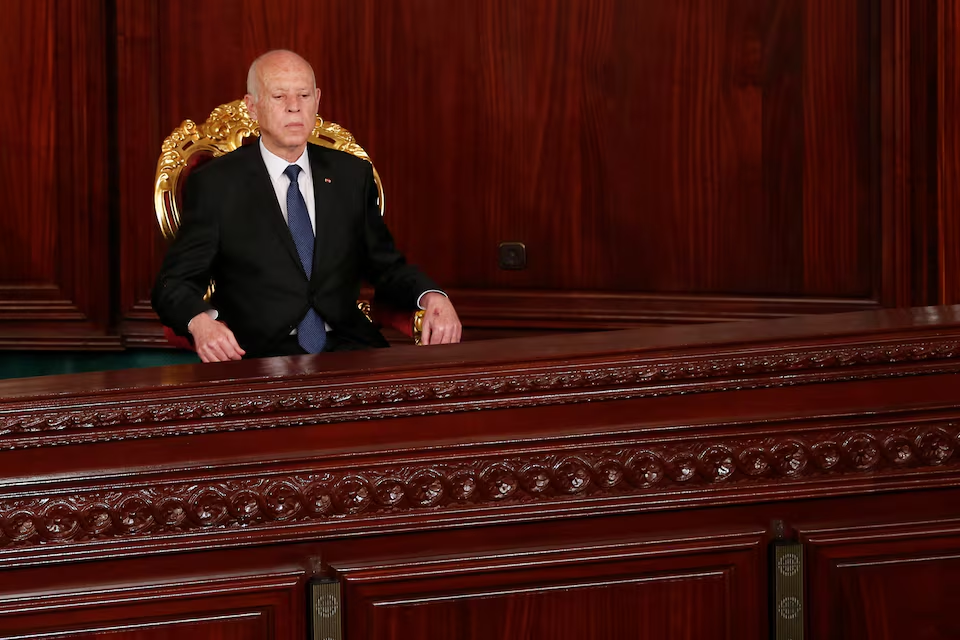
Tunisian police have arrested a member of parliament who publicly mocked President Kais Saied. Lawmaker Ahmed Saidani was detained on Wednesday, according to two of his parliamentary colleagues. The arrest appears to be part of an escalating crackdown on critics of the president. Saidani recently gained attention for his fierce criticism of Saied’s administration. On Tuesday, he mocked the president in a Facebook post. He described Saied as the “supreme commander of sewage and rainwater drainage.” Furthermore, he blasted the absence of any visible achievements under Saied’s leadership. Consequently, his arrest signals a severe response to political dissent from a sitting official.
The arrest of a parliamentarian marks a significant escalation. Tunisia has experienced increasing restrictions on free speech and political opposition since President Saied consolidated power. In 2021, he suspended parliament and later oversaw a constitutional referendum that granted the presidency sweeping authority. Since then, numerous critics, including journalists, activists, and political figures, have faced legal harassment, travel bans, or detention. Saidani’s detention for a social media post underscores the narrowing space for public criticism. It directly targets the legislative branch, which has been largely sidelined. Therefore, this move reinforces concerns about the state of democracy and rule of law in the birthplace of the Arab Spring.
Context of a Broader Crackdown on Dissent
Ahmed Saidani’s arrest is not an isolated incident. It fits a clear pattern of suppressing opposition voices in Tunisia. President Saied has frequently accused his critics of being traitors or foreign agents. The government has used laws on “spreading false information” and “cybercrimes” to prosecute online commentary. Several media figures have been summoned or arrested for their reporting. The targeting of an elected MP, however, raises the stakes considerably. It demonstrates that even formal political office offers little protection. This environment of intimidation aims to silence debate and consolidate control. Observers warn that these actions are eroding the democratic gains made after the 2011 revolution that sparked regional uprisings.
International Reaction and Domestic Implications
The international community is likely to scrutinize this arrest closely. Tunisia has been a key partner for the European Union and the United States, especially on migration and security. However, its democratic backsliding has strained these relationships. Aid and loan negotiations have sometimes been conditional on democratic standards. Saidani’s detention may prompt further diplomatic criticism. Domestically, the arrest could galvanize Saied’s opponents or further frighten them into silence. The parliament, already weakened, may see its remaining legitimacy eroded if members can be arrested for speech. This creates a chilling effect that extends beyond politics into civil society and media. The fundamental question of whether criticism of the head of state is permitted is now squarely before the public.
Legal Framework and Charges
The specific legal charges against Ahmed Saidani are not yet publicly detailed. However, past cases suggest several possible avenues. Tunisia’s penal code criminalizes “insulting the head of state.” Additionally, a 2022 cybercrime law prescribes severe penalties for online speech deemed harmful to public order or state security. Authorities may also invoke broader allegations of “conspiracy against state security.” The ambiguity of these laws allows for wide interpretation and application against critics. The lack of clarity and due process is a central concern for human rights organizations. Saidani’s status as an MP may afford him some visibility, but it does not guarantee a fair or transparent legal proceeding. His case will test the independence of Tunisia’s judiciary under the current political climate.
The Political Landscape Under President Saied
President Kais Saied was initially elected in 2019 as an anti-corruption outsider. He enjoyed broad popular support. However, his move to seize near-total power in 2021 divided the nation. Supporters view him as a necessary force against a corrupt political elite. Opponents see an authoritarian leader dismantling hard-won democratic institutions. The economy remains in crisis, with high inflation and unemployment fueling public discontent. In this context, crackdowns on critics may be an attempt to divert attention from governance failures. Arresting a parliamentarian who mocks the president’s lack of achievements directly counters narratives of incompetence. It is a show of strength intended to demonstrate control and deter similar criticism from other quarters.
Future Outlook for Free Expression in Tunisia
The arrest of MP Ahmed Saidani sets a dangerous precedent. It suggests that no one is immune from retaliation for political speech. The immediate future likely holds more prosecutions of journalists, activists, and opposition figures. Tunisia’s civil society, once robust, will operate under even greater duress. The international community faces a dilemma: how to engage with a strategically important country that is abandoning democratic norms. For Tunisians, the path forward involves navigating an increasingly repressive environment while seeking avenues for legitimate protest and expression. The hope for a democratic model in the region continues to fade. Ultimately, the treatment of Saidani will be a key indicator of whether any meaningful political space remains in Tunisia or if the country has fully entered an era of authoritarian rule.