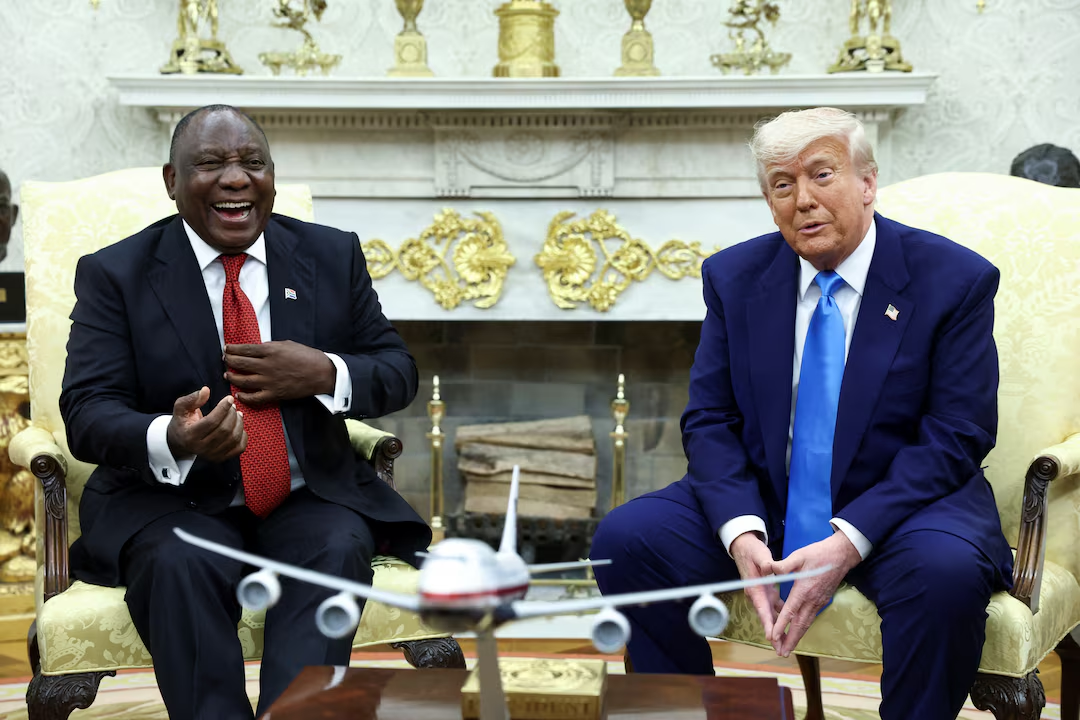
On May 21, 2025, U.S. President Donald Trump challenged South African President Cyril Ramaphosa with allegations of South Africa genocide and land seizures targeting white farmers. This unexpected confrontation during an Oval Office meeting quickly shifted the tone from diplomacy to accusation, drawing international attention to an already controversial narrative.
Ramaphosa visited Washington intending to repair diplomatic ties and promote trade. Instead, Trump derailed the agenda by showing a video and printed news clippings he claimed proved violent persecution of white South Africans. He insisted that white farmers were being murdered and their land confiscated. According to Trump, the U.S. had to respond to what he described as ongoing South Africa genocide.
Elon Musk, who was present during the meeting, has also supported the genocide narrative in past public statements. Trump emphasized that many white South Africans were fleeing to the U.S. for safety. Ramaphosa, however, stayed composed and firmly pushed back against the claims.
To counter Trump’s argument, Ramaphosa referenced the white South Africans in his delegation—golfers Ernie Els and Retief Goosen, along with billionaire Johann Rupert. He said, “If there was genocide against Afrikaner farmers, these men wouldn’t be here.” He then pointed out that while South Africa struggles with crime, most victims are Black, not white.
The data supports his statement. In 2024, South African police recorded over 26,000 murders. Only 44 were related to farming communities, and just eight victims were confirmed farmers. Ramaphosa argued that crime affects all South Africans regardless of race and rejected the idea of a targeted South Africa genocide.
Trump interrupted Ramaphosa, stating, “The farmers are not Black,” and continued to press his case. He also called for the arrest of opposition leader Julius Malema, citing violent rhetoric. His remarks drew criticism for interfering in South Africa’s internal affairs.
The theory of white genocide in South Africa has long circulated in far-right circles online, but no credible studies support it. Experts have dismissed it as misinformation. Nonetheless, Trump’s endorsement gave the theory a major platform, potentially damaging U.S.–Africa relations.
South Africa’s land reform laws permit expropriation of land without compensation, but only in cases where it is in the public interest and underused. All actions must go through the courts, and no land has been seized so far. Ramaphosa stressed that the reforms aim to fix historical injustices, not to target any racial group.
Despite the heated moment, Ramaphosa shifted focus back to trade. South Africa, the U.S.’s second-largest trading partner in Africa, wants to avoid 30% tariffs on exports. His delegation also proposed expanded cooperation on liquefied natural gas and critical minerals. Trump listened but gave no clear response.
This meeting follows a pattern of high-profile confrontations by Trump. Earlier in 2025, he took a similar approach with Ukrainian President Volodymyr Zelenskiy. Unlike Zelenskiy, who walked out, Ramaphosa remained calm and stayed throughout, hoping to maintain open dialogue.
Speaking to reporters afterward, Ramaphosa reiterated that no South Africa genocide was occurring. He invited international partners to focus on collaboration, justice, and economic development instead of divisive narratives. His calm demeanor and fact-based rebuttal stood in stark contrast to Trump’s emotionally charged presentation.