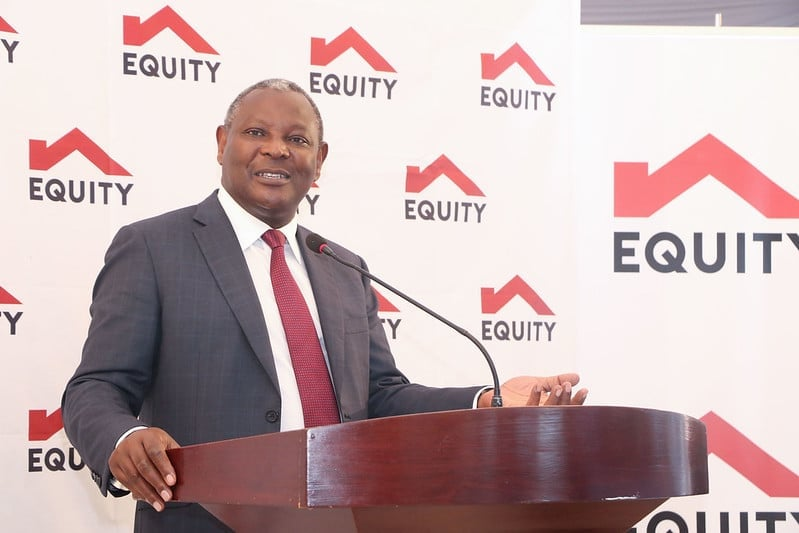
James Mwangi warned African governments that the continent risks missing a crucial investment window unless policymakers urgently address structural weaknesses that continue to discourage large-scale capital deployment.
Speaking during the Africa Forward Summit in Nairobi, James Mwangi said investor appetite for Africa remains strong, but governments are failing to convert that interest into sustained investment because of persistent fiscal uncertainty, regulatory inconsistency and weak infrastructure systems.
The Equity Group chief executive described the current moment as a defining decade for African economies, arguing that failure to implement reforms now could push investors toward more predictable emerging markets elsewhere in the world.
The summit brought together political leaders, financiers, development institutions and private sector executives to discuss Africa’s economic future, trade integration and capital mobilization strategies. Kenyan President William Ruto attended the gathering alongside Moroccan Prime Minister Aziz Akhannouch, who represented King Mohammed VI.
Mwangi’s remarks stood out because of their directness and because they came from one of Africa’s most influential banking executives at a time when the continent is competing aggressively for global investment flows.
James Mwangi Says Africa Has Capital but Lacks Structural Stability
According to James Mwangi, Africa’s biggest challenge is not a shortage of money.
Instead, he argued that investors continue to hesitate because many African economies still struggle to provide predictable operating environments necessary for long-term capital commitments.
Mwangi told summit participants that investors often arrive at African investment forums with serious interest, only to encounter policy contradictions and operational uncertainty once they begin evaluating projects on the ground.
He identified three critical barriers that governments must resolve simultaneously:
- Fiscal credibility
- Regulatory predictability
- Infrastructure depth
Without improvements in those areas, Mwangi warned that Africa could spend another decade hosting investment conferences without securing substantial capital inflows.
He emphasized that institutional investors prioritize stability and long-term visibility above promotional messaging.
Frequent tax policy changes, sudden regulatory reversals and inconsistent enforcement frameworks create risk premiums that discourage investment decisions, particularly for infrastructure, manufacturing and industrial projects that require long payback periods.
James Mwangi argued that even highly profitable sectors become unattractive when investors cannot accurately predict future operating conditions.
Fiscal Credibility Remains a Major Concern
One of the strongest points raised by James Mwangi centered on fiscal discipline and government credibility.
Across many African countries, businesses continue facing uncertainty over tax structures, debt sustainability and public finance management.
International investors closely monitor fiscal policy because it directly affects currency stability, inflation risks and sovereign borrowing costs.
Mwangi suggested that governments must create transparent and credible fiscal frameworks capable of surviving political cycles and leadership transitions.
Sudden tax increases, emergency levies and inconsistent incentives often undermine investor confidence, especially in sectors requiring billions of dollars in upfront commitments.
Africa’s debt pressures have also intensified investor caution.
Several African economies have experienced rising debt-servicing costs in recent years following global interest rate increases and currency depreciation pressures.
That environment has made fiscal management increasingly important for attracting external financing.
James Mwangi said governments cannot expect investors to commit long-term capital while fiscal uncertainty continues undermining business planning.
Regulatory Predictability Is Critical for Investors
James Mwangi also stressed the importance of predictable regulation.
Many investors entering African markets face uncertainty over licensing systems, policy implementation and dispute resolution mechanisms.
Businesses often struggle when regulations change abruptly or when enforcement varies across institutions.
Mwangi argued that stable regulatory systems are essential for reducing perceived investment risks.
He said investors need confidence that agreements signed today will still be respected years later.
Inconsistent policy implementation has historically undermined investor confidence across several African economies.
Some multinational companies have delayed or scaled back projects after facing licensing disputes, tax disagreements or sudden operational restrictions.
According to James Mwangi, governments must move beyond announcing reforms and instead focus on institutional consistency.
The challenge is particularly important as African nations compete against Asia, the Middle East and Latin America for international capital.
Investors increasingly compare operating environments globally rather than regionally.
That means African countries must provide competitive legal and regulatory conditions capable of matching other emerging markets.
Infrastructure Gaps Continue Limiting Growth
Infrastructure emerged as the third major issue highlighted by James Mwangi during the summit discussions.
Despite improvements in roads, rail and digital systems across parts of Africa, major infrastructure deficits continue increasing operational costs for businesses.
Power shortages, poor logistics networks and limited transport connectivity remain significant obstacles to industrial growth.
Mwangi said infrastructure weaknesses directly reduce Africa’s competitiveness because companies cannot operate efficiently without reliable energy, transportation and communication systems.
Manufacturers often face higher production costs due to expensive backup power solutions and logistics inefficiencies.
Infrastructure limitations also affect agriculture, mining, manufacturing and export industries.
According to James Mwangi, Africa cannot fully industrialize unless governments prioritize long-term infrastructure investment and regional connectivity.
The issue becomes even more important under the African Continental Free Trade Area framework, which depends heavily on cross-border transport and logistics systems.
Without integrated infrastructure networks, Africa’s trade ambitions could face major implementation challenges.
James Mwangi Expands Equity Group Across Africa
James Mwangi’s comments carry weight partly because Equity Group itself has become one of Africa’s most aggressive regional financial institutions.
Under his leadership, the bank has expanded across East and Central Africa while building one of the continent’s largest customer bases.
Equity Group currently operates in multiple countries and has consistently reported profitability across its regional operations.
The institution has increasingly positioned itself as a pan-African banking and financial services platform rather than a purely Kenyan bank.
Recent expansion plans include acquisition targets in Angola, Zambia and Mozambique as Equity Group pursues broader continental reach.
Mwangi has repeatedly emphasized the importance of regional integration, financial inclusion and intra-African investment flows.
His vision for Equity includes creating a banking institution capable of serving tens of millions of customers across Africa.
That expansion strategy mirrors broader trends among African financial institutions seeking to scale regionally as trade integration accelerates.
Equity Group’s growth has also reflected changing patterns in African banking, where local and regional banks increasingly compete directly with international financial institutions.
Agriculture and Market Access Also Featured at Summit
Alongside broader investment discussions, James Mwangi also participated in side events focused on agriculture and export markets.
One summit session examined how Kenyan specialty tea farmers could access premium international buyers and higher-value global supply chains.
Mwangi argued that agriculture remains one of Africa’s largest untapped economic opportunities but requires institutional support, financing access and infrastructure investment.
Many African farmers continue struggling with fragmented markets, poor logistics and limited export processing capacity.
Improving market access could significantly increase incomes and strengthen agricultural value chains across the continent.
Agriculture remains central to employment and economic activity across much of Africa, making it a major focus for policymakers and development finance institutions.
James Mwangi said Africa must move beyond exporting raw commodities and instead develop integrated agricultural processing industries capable of retaining more value locally.
Africa Competes for a Narrow Investment Window
Global competition for investment capital has intensified significantly over the past decade.
Emerging economies across Asia, the Middle East and Latin America continue implementing reforms aimed at attracting manufacturing, technology and infrastructure investments.
James Mwangi warned that Africa cannot assume investor interest will automatically translate into long-term commitments.
The continent’s demographic growth, urbanization and natural resource base continue generating global attention, but investors increasingly demand stronger institutional environments before deploying capital at scale.
Mwangi described the current period as a narrow strategic opportunity.
Africa’s young population, expanding consumer markets and regional trade integration initiatives have created strong long-term growth potential.
However, governments must convert that potential into practical operating conditions capable of supporting industrialization and business expansion.
Failure to do so, he argued, risks another decade of unrealized opportunities.
Institutional Reform Will Define Africa’s Economic Future
One recurring theme in James Mwangi’s remarks was the gap between declarations and implementation.
African governments frequently announce ambitious economic reforms and investment targets during international forums, but execution often remains inconsistent.
Mwangi said investors increasingly judge countries based on implementation records rather than policy announcements.
Reliable institutions, functioning legal systems and predictable governance structures ultimately determine where capital flows.
That reality places growing pressure on African policymakers to accelerate structural reforms.
Economic growth alone may no longer be sufficient to attract large-scale investment if governance risks remain elevated.
James Mwangi argued that Africa’s next phase of economic development depends on governments building institutions capable of supporting long-term business confidence.
Why This Matters
James Mwangi’s warning reflects broader concerns about Africa’s ability to compete for global investment during a period of rising economic uncertainty and geopolitical competition.
The continent has strong demographic and resource advantages, but investors increasingly prioritize policy stability, infrastructure and governance quality when allocating capital.
If African governments successfully implement structural reforms, the continent could unlock significant industrial and financial growth over the next decade.
Failure to act could push investors toward alternative emerging markets with more predictable business environments.
What Happens Next
Governments attending the Africa Forward Summit are expected to outline policy implementation plans and regulatory reforms in the coming months.
Investors and financial institutions will closely monitor whether summit commitments translate into concrete legislative and institutional changes.
For James Mwangi and Equity Group, the broader challenge will be whether African economies can build the stability and infrastructure necessary to support the next generation of continental investment and industrial expansion.