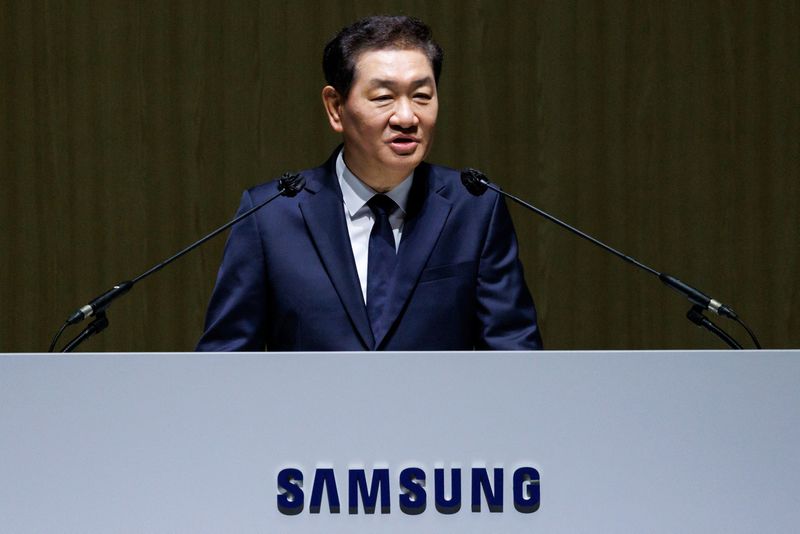
SEOUL – Samsung Electronics announced on Tuesday that co-CEO Han Jong-hee has died of a heart attack at age 63, marking a sudden and significant leadership shift at the world’s largest memory chipmaker.
Han passed away while undergoing treatment for cardiac arrest at a hospital, according to a company spokesperson. His death leaves newly appointed co-CEO Jun Young-hyun as the sole CEO of South Korea’s most valuable company.
The announcement comes just days after Jun’s appointment during Samsung’s annual shareholders meeting, where he was elevated to co-CEO following his promotion last year to head the company’s semiconductor division—a sector where Samsung has struggled to keep up with rivals like SK Hynix and TSMC, particularly in the race for dominance in AI chip technology.
A Legacy Cut Short
Han, who joined Samsung nearly 40 years ago, built his reputation in the television business, transforming Samsung into a global leader in display technology. He became co-CEO in 2022, overseeing the company’s consumer electronics and mobile devices division, and also served on the board of directors.
“Han was the key figure behind making Samsung’s TV business influential on a global scale,” said one industry analyst, who noted that his unexpected passing could alter the company’s long-term strategic direction, especially in areas like marketing and product innovation.
Challenges Ahead
Han’s death comes at a turbulent time for Samsung. The company is facing weak earnings, a slumping stock price, and pressure from investors over its inability to capitalize on the booming AI semiconductor market.
Samsung’s semiconductor business, once a cornerstone of its global dominance, has lagged in developing high bandwidth memory (HBM) chips, crucial components for AI graphics processing units used by companies like Nvidia (NASDAQ:NVDA).
Han acknowledged these shortcomings at the shareholder meeting last week, where he told investors:
“I sincerely apologise for the recent stock performance not meeting your expectations. Over the past year, our company failed to adequately respond to the rapidly evolving AI semiconductor market.”
He also noted that 2025 would be a challenging year, especially with the return of U.S. President Donald Trump and renewed trade tensions. Han had pledged Samsung would respond flexibly to tariffs using its global manufacturing footprint.
Company in Transition
With Han’s passing, Jun Young-hyun now assumes full leadership of Samsung Electronics. The company has not yet named a replacement board member, and it remains unclear how internal responsibilities will be redistributed.
Samsung shares closed down 0.66% on Tuesday, mirroring the broader South Korean market.
Sources suggest that Samsung is looking to expand into automotive electronics to find new growth avenues. Meanwhile, Chairman Jay Y. Lee is currently in China, attending the China Development Forum. According to media reports, he visited Xiaomi’s car factory in Beijing and BYD’s headquarters in Shenzhen, signaling potential future moves in the electric vehicle supply chain.
Samsung declined to comment on Lee’s visit.
Lee, who took over the company after his father Lee Kun-hee’s incapacitation in 2014, was recently cleared of charges in a high-profile succession case. However, prosecutors have appealed the ruling, keeping legal pressure on the conglomerate’s leadership.
Han Jong-hee’s passing leaves a profound void in Samsung’s executive leadership, as the company works to recover lost ground in semiconductors, reclaim its smartphone market share, and chart a path through geopolitical and technological disruption.
The industry now watches closely as Jun Young-hyun takes the reins—alone.