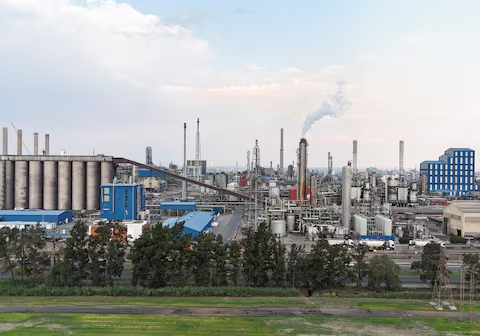
South African petrochemical company Sasol has received certification from a German agency for its sustainable aviation fuel. This certification paves the way for Sasol to start exports to the European Union. A senior company executive announced this development on Thursday. Sasol’s SAF uses cooking oil and vegetable oil. The company produces this fuel at its 108,500 barrel-per-day Natref plant. Germany’s TUV SUD agency granted ISCC Plus sustainability certification. The agency also certified sustainable chemicals from Sasol’s sister Secunda complex. Therefore, the Sasol green jet fuel can now enter the European market.
“South Africa has a lot of used cooking oil which is being collected,” said Sarushen Pillay, Sasol’s VP of strategy and technology. “It is taken to Durban and exported to Rotterdam in the EU. They make it there.” He added: “Now, we will be able to make it in South Africa.” He did not say when Sasol hopes to start exports to the EU.
War Creates Urgent Demand for Jet Fuel
The U.S.-Israeli war with Iran has severely crimped jet fuel supplies globally. The EU is among the worst-hit regions. Skyrocketing prices and dwindling stocks are affecting airlines. Europe faces a potentially catastrophic summer tourism season. Therefore, the Sasol green jet fuel comes at a critical time.
Depending on customer demand, Natref is targeting one to two million litres this year. The plant is converting into a hybrid bio-refinery. It aims for around 16 million litres in 2027. The target rises to up to 100 million litres by 2030. Sasol aims to reduce its carbon footprint. It is also preparing for new cleaner fuel specifications. “If we include Secunda then we are looking at 200 million litres of SAF by 2030,” Pillay said.
Sasol Partners with Anglo American and De Beers
Sasol is one of Africa’s worst industrial polluters. The company has partnered with Anglo American and De Beers. They will use plants such as Solaris crops, which have high oil yield. These crops will help develop a biolipid feedstock. This feedstock will support Sasol’s overall SAF production portfolio. The Sasol green jet fuel initiative thus addresses both environmental and commercial goals.
The certification allows Sasol to compete in the European SAF market. The EU has set ambitious targets for sustainable aviation fuel. Airlines must blend increasing percentages of SAF into their fuel. This creates a growing demand that Sasol can now help meet. South Africa’s abundant supply of used cooking oil gives the company an advantage.
Production Targets and Timeline
Sasol’s production targets are ambitious but achievable. The company will ramp up gradually over several years. The Natref plant’s conversion to a hybrid bio-refinery is key. This conversion requires significant investment. However, the potential returns are substantial. European airlines are desperate for SAF supplies.
The Secunda complex will add even more capacity. Combined production of 200 million litres by 2030 would make Sasol a major SAF producer. This would reduce Europe’s dependence on Middle Eastern jet fuel. It would also create jobs in South Africa. The Sasol green jet fuel project represents a win-win opportunity.
The company faces challenges. Collecting enough used cooking oil is one issue. Maintaining consistent quality is another. Competition from other SAF producers will increase. However, Sasol’s first-mover advantage in Africa is significant. The ISCC Plus certification gives it credibility. European buyers trust this certification standard.
Sasol must now secure offtake agreements with European airlines. Negotiations are likely underway. The summer travel season is approaching rapidly. Airlines need SAF now, not later. This urgency works in Sasol’s favor. The coming months will reveal whether the Sasol green jet fuel reaches European tanks in time. Either way, the company has positioned itself for long-term growth in the sustainable aviation fuel market.