Austria is seeking to expand renewable energy and increase gas imports from Africa to avoid becoming overly dependent on U.S. liquefied natural gas. The country’s junior energy minister shared this strategy with Reuters on Wednesday. European countries are wrestling with how to keep electricity prices affordable as the European Union phases out Russian gas. The bloc aims to eliminate Russian gas by 2027 in response to Moscow’s 2022 invasion of Ukraine. Consequently, many governments fear replacing one dependency with another under U.S. President Donald Trump.
“The U.S. is not predictable in these times, so for Austria we are really looking closely to ensure we have LNG from different sources,” said Elisabeth Zehetner, Austria’s state secretary for energy. Zehetner is among ministers from 38 OECD countries meeting in Paris. They are discussing energy security at an International Energy Agency gathering. The meeting addresses critical questions about supply diversification and reliability.
Living with Dependencies
“Since the beginning of last year, we do not import any Russian gas, but we face now the same topic with LNG,” Zehetner explained. She noted that more than 40% of Europe’s LNG imports now come only from the United States. Therefore, European nations must ask whether they have exchanged one dependency for another. This question drives Austria’s search for alternative suppliers.
U.S. Energy Secretary Chris Wright criticized the IEA’s focus on renewables and climate policy on Tuesday. He urged Europe to purchase more U.S. LNG at what he described as low prices. However, European ministers remain cautious about over-reliance on any single supplier. The American political landscape introduces uncertainty about long-term supply arrangements.
Commitment to Renewables
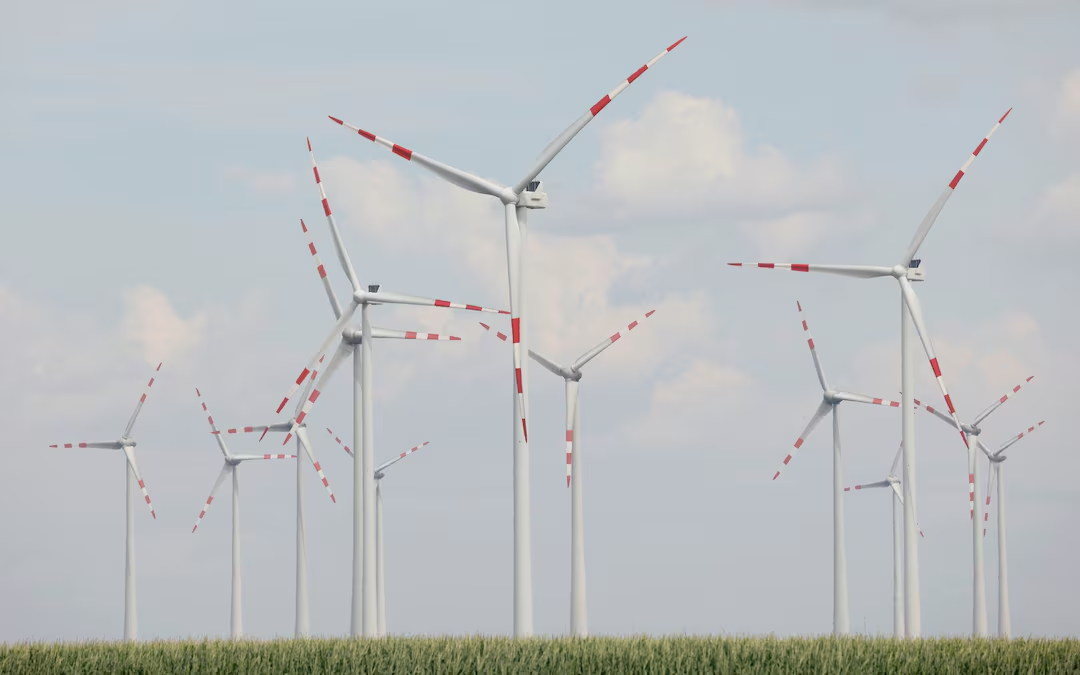
Most ministers at Wednesday’s first session reaffirmed their commitment to expanding renewable power. Zehetner reported that domestic generation offers greater reliability than any kind of imports. Renewables provide energy that countries control directly without foreign policy complications. Additionally, renewable power becomes increasingly cost-competitive with fossil fuels.
However, Zehetner acknowledged that natural gas remains essential for stable supply. “We know we will still be dependent on gas for many decades to come,” she said. Therefore, the question becomes how Europe lives with these dependencies. The answer involves both reducing overall gas needs and diversifying sources.
African Gas Potential
Austria hopes to increase gas imports from Africa via the Transmed pipeline that lands in Italy. This pipeline connects North African gas fields with European markets. It offers a route that avoids both Russian and American supply chains. Therefore, it represents an attractive diversification option for Austrian planners.
Romania’s Neptun Deep field in the Black Sea provides another potential source. Austrian firm OMV is developing this field, which starts producing next year. Having domestic European companies involved adds reliability to the supply chain. Austria already imports from Norway, the U.S., and Qatar, but seeks broader options.
Lessons from Russian Dependence
Zehetner emphasized that Austria has learned painful lessons from past energy dependence. The experience of Russian gas reliance taught European countries important lessons. Therefore, policymakers now prioritize diversification even when immediate supplies seem secure. This thinking shapes Austria’s approach to U.S. LNG as well.
When asked about a potential return to Russian gas, Zehetner expressed openness only under specific conditions. Austria would prefer to buy renewable energy from Ukraine if possible. However, she added that if a peace deal acceptable to Kyiv emerged, some Russian gas could again be considered. This conditional openness reflects pragmatic energy planning.
Core Principle of Non-Dependence
“Concerning the role of Russia … we have learned our lesson, so we do not want to be dependent on anyone,” Zehetner stated firmly. This principle now guides Austrian energy policy across all supply sources. It explains the push for both renewables and diversified gas imports. It also accounts for skepticism about excessive U.S. LNG reliance.
The strategy aims to balance multiple sources rather than maximize any single one. This approach provides resilience against disruptions from any direction. It also maintains bargaining power with all suppliers. Therefore, Austria eyes renewables and African gas as complementary strategies rather than alternatives to each other.
European Context
Austria’s concerns reflect broader European anxiety about energy security. The continent rapidly reduced Russian gas following the Ukraine invasion. However, U.S. LNG filled much of that gap, creating new dependencies. European Commission officials have warned about this risk repeatedly. Member states now seek to balance their energy portfolios accordingly.
The EU’s 2027 deadline for ending Russian gas imports adds urgency. Countries must secure alternative supplies while maintaining affordability. This challenge drives investment in both domestic renewables and foreign gas infrastructure. Austria’s approach mirrors strategies emerging across the continent.
IEA Meeting Dynamics
The Paris gathering reveals tensions between different energy visions. U.S. officials promote American LNG as the solution to European needs. However, European ministers increasingly question this narrative. They note that LNG prices have not always remained low as promised. They also worry about political conditions affecting future supplies.
Renewable energy advocates within the IEA argue for faster transition away from all fossil fuels. They point to falling costs and improving technology. However, pragmatic ministers acknowledge that gas will remain necessary for years. Therefore, the discussion focuses on managing the transition realistically.
Infrastructure Considerations
Expanding African gas imports requires adequate pipeline capacity. The Transmed pipeline currently transports Algerian gas to Italy. Expanding this route would require investment and possibly new construction. European financing could support such infrastructure development as part of diversification strategy.
Similarly, Black Sea gas development depends on regional cooperation. Romania’s Neptun Deep field will produce significant volumes. Connecting this gas to Austrian markets requires pipeline capacity through Southeast Europe. These infrastructure considerations add complexity to diversification plans.
Timeline for Implementation
Some diversification options will take years to materialize fully. Black Sea gas begins flowing next year but at initial volumes. African pipeline capacity expansion requires multi-year projects. Therefore, U.S. LNG will remain important during the transition period. Austria acknowledges this reality while working to reduce long-term dependence.
Renewable expansion proceeds on its own timeline. Wind and solar projects can deploy relatively quickly. However, replacing gas-fired generation requires much larger renewable capacity. Therefore, Austria eyes renewables as long-term solution while addressing medium-term gas needs.
Economic Implications
Energy strategy carries significant economic consequences for Austria. Manufacturing industries depend on reliable, affordable power. Households face cost-of-living pressures from energy prices. Therefore, diversification must balance security with affordability. Cheaper options may win even if they increase dependence.
U.S. LNG has often proven competitive on price. However, recent volatility raises questions about long-term cost stability. European policymakers weigh these factors against geopolitical considerations. The optimal mix varies by country based on existing infrastructure and industrial structure.
Looking Forward
Austria will continue developing both domestic renewables and diversified gas imports. The two strategies complement rather than compete with each other. Renewables reduce overall gas requirements while diversification secures remaining gas needs. This balanced approach reflects lessons learned from Russian dependence.
International cooperation remains essential for energy security. Pipeline projects require multiple countries to coordinate. LNG markets depend on global trade relationships. Therefore, Austria participates actively in forums like the IEA meeting. These gatherings help coordinate responses to shared challenges. Austria eyes renewables and African gas as components of a more secure energy future.