
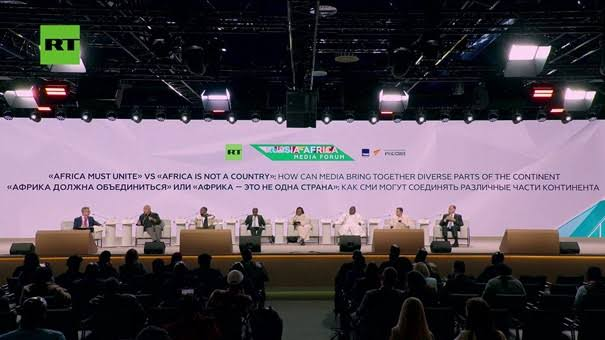
African media organisations can find common ground through local reporting without presenting the continent as a single, uniform society. That was a central theme emerging from discussions at the Russia-Africa Media Forum in Moscow.
The forum’s opening-day panel on October 26 brought together representatives from countries including Rwanda, Namibia, Kenya, Tanzania, Egypt, Mali, Seychelles and Algeria.
Their challenge was practical: how can newsrooms connect stories across borders when their audiences speak different languages, live under different political systems and face distinct local realities?
The discussion, reported by Broadcast Media Africa, produced no agreement on a single African narrative. It did, however, highlight a shared concern that African journalists should play a greater role in determining how their communities are represented.
Local reporting as the foundation of a wider African story
One of the clearest arguments was that cooperation should begin with reporting grounded in local experience.
The Kenyan contribution emphasised that audiences recognise shared concerns when journalists tell individual communities’ stories well. A report about employment, education or access to services can resonate beyond its original setting without losing its local detail.
This approach gives substance to the idea of African solidarity. It allows connections to emerge from reporting rather than requiring every newsroom to adopt the same interpretation.
For editors, the implication is straightforward: a story should explain the people and circumstances at its centre before attempting to represent an entire country or continent.
Diversity offers editorial strength
Peter Denk of the Namibian Broadcasting Corporation argued that the range of countries represented on the panel demonstrated an opportunity.
He referred to research by Africa No Filter and the University of Cape Town while discussing weaknesses in international coverage of Africa. His concern included the limited attention given to ordinary people’s experiences.
His broader point was that differences between African societies can enrich journalism. Newsrooms can learn from one another’s reporting while retaining the context that makes each story meaningful.
A shared editorial interest in people’s lives need not produce identical coverage. The same issue can have different causes, consequences and possible solutions in neighbouring countries.
Read Also:Trump Iran Strikes Boost Russia Oil Revenue
Language remains a barrier to collaboration
Participants also identified language as a significant obstacle to sharing journalism across borders.
Translation can widen access, but reaching a new audience often requires additional explanation. Readers or viewers may be unfamiliar with a country’s institutions, history or political references.
Emmanuel Munyarukumbuzi of the Rwanda Broadcasting Agency discussed how reporting can be adapted for different language audiences while retaining a common subject.
His contribution pointed towards an approach built around shared concerns and aspirations. Newsrooms can cover related issues while choosing the language and context most useful to their audiences.
That creates a distinction between adapting a story and changing its underlying facts. Effective collaboration requires accuracy to survive both translation and editorial presentation.
Russia’s role brings questions about partnership
The forum also raised questions about the relationship between African newsrooms and international media partners.
An Algerian panellist described Russia as a friend willing to support African countries, linking that assessment to the history of colonial dependence. That was the speaker’s political position, rather than a conclusion established by the discussion.
The report also cited Ghana Broadcasting Corporation Director General Professor Amin Alhassan, who has expressed concern about reliance on Western assessments of international affairs.
Such arguments reflect interest in widening the range of sources available to African audiences. The value of any partnership, however, depends on whether it strengthens a newsroom’s ability to make independent editorial decisions.
Equal partnerships require editorial freedom
In separate forum coverage, the Seychelles News Agency reported calls for cooperation based on equality, mutual respect and journalistic independence.
That provides a useful standard for assessing international agreements. Shared content, training and professional exchanges can help newsrooms, but participating journalists must retain the ability to question information and choose what serves their audiences.
Practical questions include:
| Partnership issue | Editorial question |
|---|---|
| Shared reporting | Who decides the angle and verifies the facts? |
| Translation | Does the adapted version preserve meaning and context? |
| Content distribution | Will audiences know who produced the material? |
| Training | Does it strengthen independent reporting skills? |
| Editorial control | Can a newsroom challenge or decline supplied content? |
These considerations apply to partnerships with any international media organisation.
A common purpose does not require one viewpoint
The Moscow discussion exposed the limits of asking whether Africa should have one story or many.
The more useful question is whether African newsrooms have the resources, access and independence to report their own societies fully—and to share that work across borders.
Cooperation could help smaller outlets reach wider audiences and give regional stories greater international visibility. Its credibility will depend on preserving disagreement and local knowledge alongside shared interests.
The forum’s unresolved debate therefore leaves a practical task for editors: build stronger connections between newsrooms while keeping authority over the journalism they publish.
Read Also; Olam Agri Plans $400 Million Investment as Africa’s Food Demand Changes