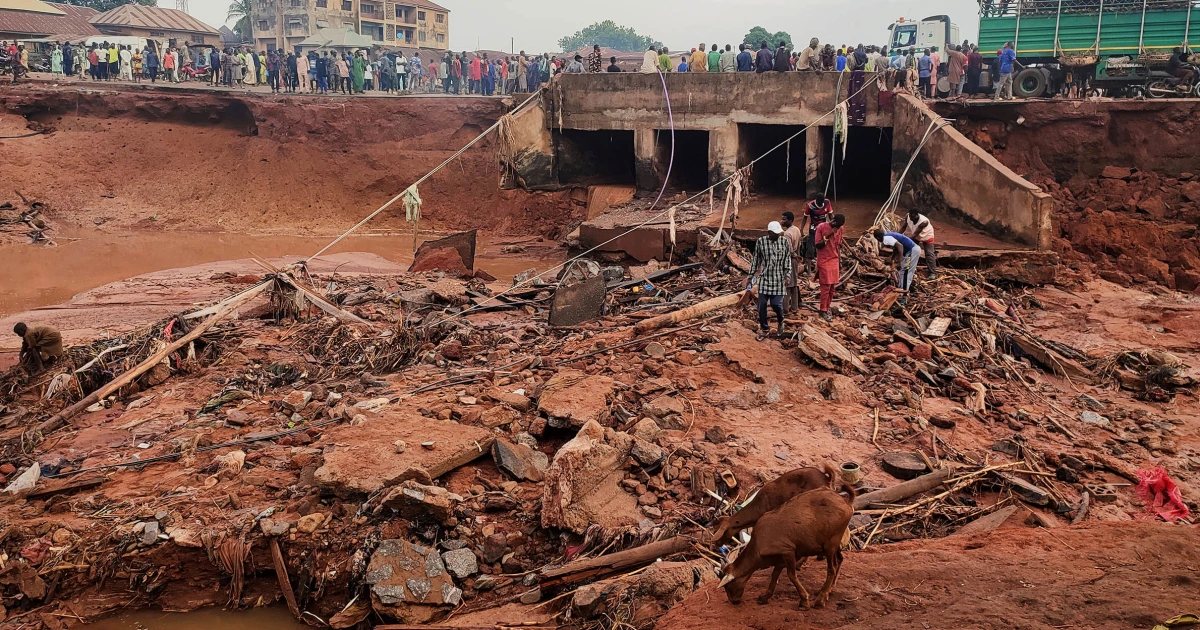
More than 700 people are feared dead after massive floods tore through Mokwa town in Nigeria’s central Niger State, in what officials describe as the worst disaster in the region in 60 years.
Local authorities have confirmed over 200 fatalities, with another 500 individuals still missing. Efforts to locate survivors have officially ended, as officials believe there is little chance of finding anyone alive.
The catastrophic flooding struck on Thursday, triggered by torrential rains that caused rivers to overflow in the Tiffin Maza and Anguwan Hausawa districts of Mokwa.
Eyewitnesses Share Harrowing Tales
Survivors spoke to the BBC, recounting how entire homes and families were swept away in minutes.
“I watched helplessly as my wife and newborn were washed away,” said local resident Adamu Yusuf, who only survived because he could swim.
Another man, Saliu Sulaiman, lost not only his home but also $1,500—his earnings from selling farm produce the previous day. “I thought of going back to retrieve it, but the water was too strong,” he said.
Some residents believe the severity of the flooding may have been worsened by a nearby dam failure, although this has not been officially confirmed.
Authorities Begin Relief and Recovery
In the aftermath, the National Emergency Management Agency (NEMA) began distributing relief packages to affected families. Roads and bridges have been destroyed, paralyzing local commerce and travel.
Mokwa’s district head, Muhammadu Aliyu, announced that local health officials would begin recovering bodies buried beneath the floodwaters to prevent disease outbreaks.
The Nigerian Red Cross described the situation as one of “significant loss of life and widespread distress.”
A Recurring National Crisis
Flooding during Nigeria’s rainy season, which runs from April to October, is a regular but increasingly devastating issue.
In 2022, floods killed more than 600 people and displaced over 1.3 million. In 2024, several states also faced fatal flash floods.
This latest disaster in Mokwa underscores the urgent need for climate resilience, early warning systems, and stronger infrastructure across Nigeria’s flood-prone regions.