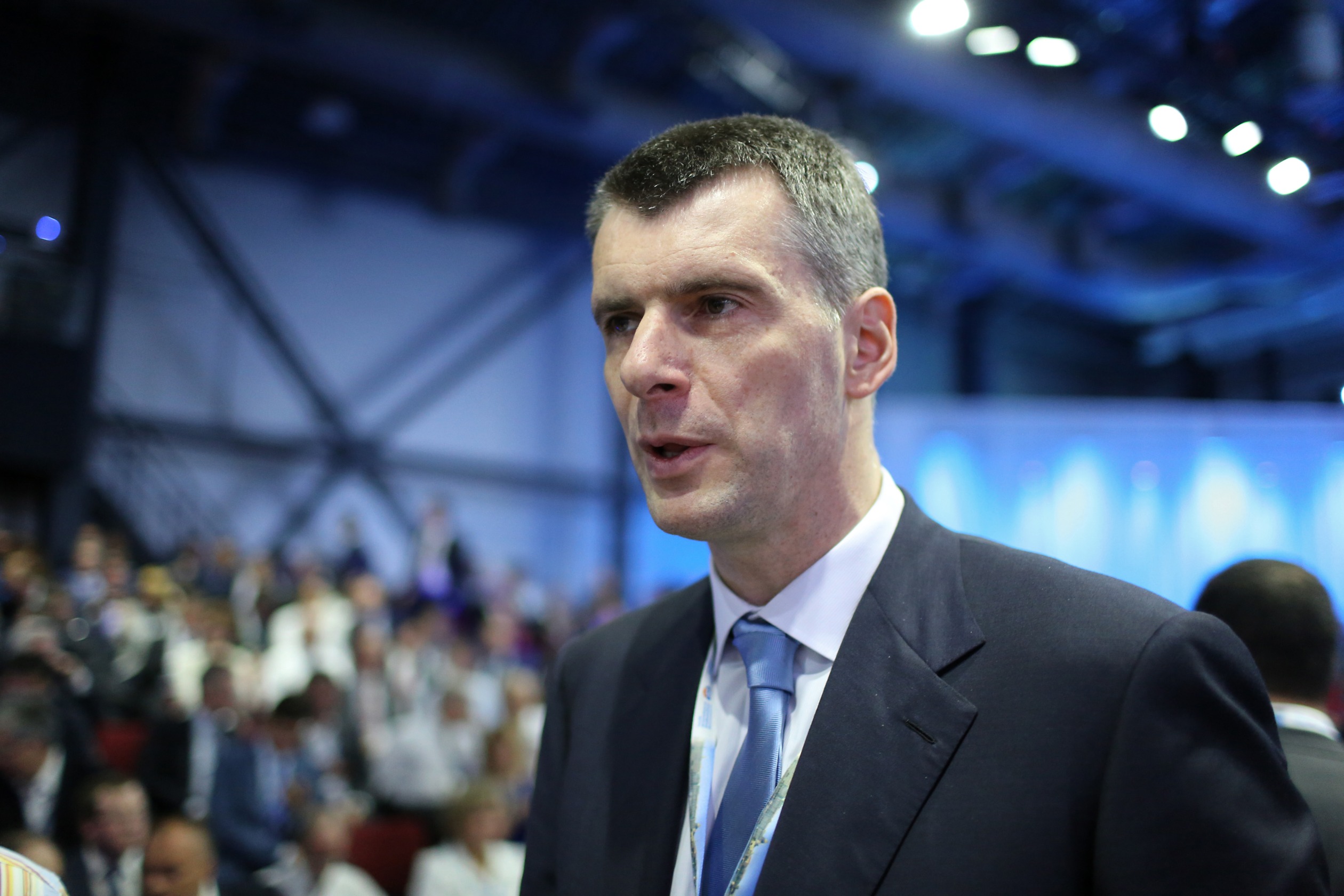
Mikhail Dmitrievich Prokhorov (Russian: Михаил Дмитриевич Прохоров, IPA: [mʲɪxɐˈil ˈdmʲitrʲɪjɪvʲɪtɕ ˈproxərəf]; born 3 May 1965) is a Russian-Israeli oligarch, politician, and former owner of the Brooklyn Nets. In April 2022, Prokhorov reportedly obtained Israeli citizenship.
After the collapse of the Soviet Union, Prokhorov obtained Russian state-owned metals assets at prices far below market value in Russia’s controversial loans-for-shares privatization program. His company, Norilsk Nickel, became the world’s largest producer of nickel and palladium. He is the former chairman of Polyus Gold, Russia’s largest gold producer, and the former President of Onexim Group. As of December 1, 2021, Bloomberg Billionaires Index estimates his wealth at US$14.0 billion and has named him the 148th richest person in the world, while Forbes Magazine lists his wealth at US$11.5 billion and the 193rd richest person in the world.
In 2011, Prokhorov ran as an independent candidate in the 2012 Russian presidential election. He was third in voting, amassing 7.94 percent of the total vote. In June 2012, he declared the establishment of the new Russian political party called Civic Platform.
The majority of Prokhorov’s fortune is derived from the proceeds of asset sales he began making in 2007, when he and billionaire partner Vladimir Potanin began to split the metals holdings they amassed after the fall of the Soviet Union. He has received more than $12 billion in cash since 2007, including about $5 billion from United Company Rusal for his 25% stake in Norilsk Nickel.
Prokhorov sold his 38% stake in Polyus Gold for $3.6 billion in February 2013. He bought a 28% stake in Uralkali, a potash producer, in January 2014, paying more than $3.5 billion, and sold it in July 2016.
Prokhorov sold 49% of the Brooklyn Nets basketball club to Joseph Tsai in 2018 and the rest in 2019.
His closely held banking and insurance interests include Renaissance Capital, Renaissance Credit, IFC-bank and Soglassiye Insurance.
Early life
Prokhorov was born in Moscow to Tamara and Dmitri Prokhorov. On his paternal side his grandparents were Russians, relatively wealthy peasant farmers (known as kulaks) who were persecuted as class enemies under the Bolsheviks and again under Stalin. His father, one of eight children, grew up poor, after his family “lost everything and was forced to flee from one part of Siberia and restart life in another”. He has one sibling, an elder sister, Irina. On his maternal side his grandfather was Russian, and his grandmother Anna Belkina, was a Jewish microbiologist who remained in Moscow during World War II to make vaccines while her daughter Tamara was moved east to safety.
Dmitri Prokhorov was trained as a lawyer and handled international relations for the Soviet Committee of Physical Culture and Sport. Tamara Prokhorova was a materials engineer at the Institute for Chemical Machine-Building. As part of his job, Dmitri Prokhorov had the opportunity to travel abroad. His wife worked as an engineer for a research group at the institute specializing in plastics. They died within a year of each other, both from heart disease when they were in their late 50s. Mikhail Prokhorov’s sister, Irina, who “runs his philanthropic organizations, an erudite literary magazine, and a publishing house … lives in a wing of his mansion west of Moscow”.
In 1989, he graduated from the Moscow Finance Institute. From 1989 to 1992, he worked in a management position at the International Bank for Economic Cooperation. Thereafter, he shortly served as head of management board of the MFK bank (International Finance Company) (Russian: «Международная финансовая компания» (МФК)) and then in 1993 the newly formed United Export-Import Bank (Russian: “ОНЭКСИМ-банк”) (Uneximbank; akas: Onexim Bank; Oneksimbank), with Alexander Khloponin, a friend from college, and Vladimir Potanin, to whom he was introduced by Khloponin and who became his business partner. Oneksimbank is the financial twin of MFK and was also known as the ONEKSIMbank-MFK banking group which was also close to Andrey Vavilov.
Business career
In 1992, at the age of 27, Prokhorov partnered with Potanin to run Interros, a holding company that they used in 1995 to effect the purchase of Norilsk Nickel, one of Russia’s largest nickel and palladium mining and smelting companies. During the largely un-regulated privatization of former state-controlled industries after the collapse of the USSR, Prokhorov and Potanin (the latter by then a deputy prime minister who oversaw privatization) were able acquire the shares from the workers of Norilsk Nickel for a fraction of their estimated market value and seize ownership of the company. When he departed in 2007, Prokhorov’s share of the company was worth US$7.5 billion.
Prokhorov’s first major financial success came at MFK, which became a depository institution for the government. The bank acquired Soviet assets in the amount of US$300 to US$400 million. Prokhorov held the post of chairman of the board from 1992 until 1993. In 1993, Prokhorov became the chairman of the board for Potanin’s Onexim Bank, which, in 1993, became the paying agent for Finance Ministry bonds and a servicing bank for the City of Moscow’s external economic activities. In May 1994, Onexim Bank focused on large clients in foreign economic activity especially in the sectors of oil and gas, chemical and metallurgical industries. In 1994, Onexim became the depository and paying agent for Russian Treasury obligations, and in 1995, it became the authorized bank for the federal agency dealing with bankrupt enterprises.
Banks holding government funds earned handsome fees and paid minimal interest at a time when inflation was in the triple digits.[12]
In the 1990s, the Russian government needed loans to operate. Prokhorov partnered with Potanin. Their Onexim bank ran auctions for the government, in which bidders won the right to loan the Russian government money. Onexim and its affiliates were the winning bidders at the Norilsk Nickel and other auctions they conducted. The Russian government secured the loans with blocks of shares of the newly privatized state enterprises. The government never repaid the loans, and, as a result, Onexim received ownership of the collateral, which was the shares in the privatized enterprises.
When cash privatization eventually replaced the failing voucher privatization phase, the government came up with a scheme to leverage the privatization process and quickly raise money for its cash-strapped operations. Under the “loans for shares” program, the administration sold off majority stakes in some of its prized companies in the energy, telecommunications, and metallurgical sectors in exchange for loans taken from the new private sector banks owned by rich businessmen. According to the terms of the loan, the lender could stake equity ownership in the company if the government failed to repay the loans by September 1996. Auctions conducted under the “loans for shares” program were executed in such a way that only the few businessmen who owned these banks were allowed to partake in auctions. Following these bogus auctions, the majority stakes in some of the biggest Russian companies were acquired by a small number of major banks at abysmally low prices. These businessmen also bankrolled Yeltsin’s 1996 presidential election victory, exerting their influence over the then president.
Onexim purchased Sidanko, which was a part of the Novolipetsk metallurgical industrial complex, and also the Novorossiisk marine shipping company and a large share of the Northwest marine shipping company. All of these enterprises were purchased by Prokhorov and Potanin for approximately one third of their estimated market value.
In April 1996, Prokhorov was appointed to the Board of Directors of Norilsk Nickel (which then still belonged to the state). In November 1995, Onexim Bank won 38% of Norilsk Nickel in a loans-for-shares auction for US$170.1 million, US$100,000 (or less than 1%) higher than the bid starting price. At the time, Norilsk produced 25% of the world’s nickel output.
Onexim managed the Norilsk Nickel auction, with a reservation price of US$170 million. It arranged three bids from affiliates, all at US$170 or US$170.1 million. Rossiiski Kredit Bank offered US$355 million, more than twice the starting amount. However, Onexim disqualified Rossiiski Kredit’s bid on the basis that the bid amount exceeded Rossiiski Kredit’s charter capital (the nominal value of its outstanding shares). The auction rules required Onexim to provide any objections in advance of the auction, to give bidders time to cure them. None of the submitted bids even closely approximated the market value of Norilsk Nickel, which had annual profits of around US$400 million.
60 Minutes, the American news program, interviewed Prokhorov. The program alleged that:
“Kremlin leaders gave him what amounts to an insiders opportunity to buy one of the state’s most valuable assets. It was acquired from the Kremlin in a so-called auction for the measly sum of a few hundred million dollars in a process that even Prokhorov’s business partner admits wasn’t perfect, and probably not even legal under Western standards. But it was legal in Russia”.
During the interview, Russian business correspondent Yulia Latynina stated about the auction of Norilsk Nickel, “Yes, it was rigged. But, it cannot be explained in normal economic terms to an outsider, especially an American. You had robber barons, we have oligarchs.”
In December 2011, Prokhorov capped a year of higher-profile political activity in Russia with the December declaration that he would run as an independent in the 2012 presidential elections. He took third place in these elections with 7.94% of the vote. In June 2012, he declared the establishment of a new political party called the “Party of Civic Platform”. He resigned his positions as Chairman of Polyus Gold and President of the ONEXIM Group to enter politics in June 2011.
In August 2017, Prokhorov agreed to sell 7% of Rusal to fellow billionaire Viktor Vekselberg for $503.9 million. Talks between the two had stalled earlier in the year with Prokhorov selling 3.3% via an accelerated bookbinding.
In October 2017, Prokhorov and Viktor Vekselberg sold 3% of Rusal for $315 million in an accelerated bookbuilding. The sale of Prokhorov’s 0,7% reduced his stake in the company to 6%
Milestones
- 1965 Mikhail Dmitrievich Prokhorov is born in Moscow.
- 1989 Graduates from Moscow State Finance Institute.
- 1992 Prokhorov and Potanin register their IFC Bank.
- 2007 Arrested in France on suspicion of arranging prostitutes.
- 2010 Buys control of the NBA’s Nets; moves team to Brooklyn in 2012.
- 2011 Heads Right Cause Party; loses presidential bid to Putin in 2012.
- 2013 Buys a 27.1 percent stake in Uralkali for about $4.9 billion.
- 2016 Sells his stake in Uralkali.
- 2017 Sells a 49 percent stake in the Brooklyn Nets to billionaire Joseph Tsai.
- 2019 Sells a 51 percent stake in the Nets and the Barclays Center to Tsai.
Personal life
Prokhorov has never been married, but has been engaged twice. Shortly after purchasing the Nets, he vowed to get married if the Nets had not won the NBA championship within five years. In July 2015, he rescinded the pledge, saying that NBA Commissioner Adam Silver had “taken his place” by marrying his fiancée in May.
Awards
In August 2006, he was awarded the Order of Friendship for his significant contribution to the growth of Russia’s economic potential, when the President of the Russian Federation, Vladimir Putin, signed an order for the granting of state honors on 18 August 2006. In March 2011, he was bestowed with the French Legion of Honour. France’s ambassador to Moscow, Jean de Gliniasty, presented it at the French embassy in Moscow