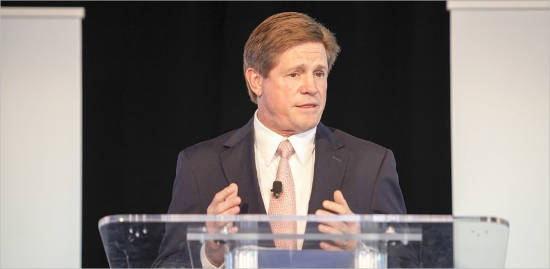
Andrey Igorevich Melnichenko (Russian: Андрей Игоревич Мельниченко; Belarusian: Андрэй Iгаравiч Мельнічэнка; born 8 March 1972) is a Russian-Emirati billionaire entrepreneur. He is the founder and ex-beneficiary of fertilizer producer EuroChem Group and coal producer SUEK, and was a non-executive director in both companies until 9 March 2022.
In 2022 Forbes and Bloomberg estimated his net worth at $15.8 billion and $17.4 billion respectively, which makes him one of the richest persons in Russia. In the 2023 ranking, for the first time, he took first place among Russian billionaires with a fortune of $25.2 billion.
After the Soviet Union fell, he began trading currency with two friends while a physics student at Moscow State University, and then registered a bank, MDM Bank.
Melnichenko took an interest in the commodities market and began buying assets in coal and fertilizers, with the acquisition of plants and mines, many of which were distressed. He founded fertilizer producer Eurochem and coal energy company SUEK.
The majority of Melnichenko’s fortune is derived from stakes in two closely held Russian companies, EuroChem and Suek. Suek is headquartered in Moscow, Russia and EuroChem is based in Zug, Switzerland.
The trust established by Melnichenko controlled 90% of EuroChem, according to company’s 2020 annual report. He also held a 92.2% stake in Suek, Russia’s largest thermal coal supplier, according to its website.
Melnichenko withdrew as beneficiary a trust that holds the shares of Suek and EuroChem in March 2022 ahead of European Union sanctions. His wife, Aleksandra Melnichenko, became the beneficiary of it. Stakes in EuroChem and Suek remain credited to him in this analysis to reflect his status as the founder and key investor.
The value of the billionaire’s cash investments and personal assets is based in part on local media reports and figures provided by his press representatives. He’s netted more than $800 million based on available information about Suek and Eurochem dividends, the purchase and sale of stakes in those closely held business, and spending on personal assets. He’s also collected more than $500 million from dividends and share sales of publicly traded companies through December 2017, based on an analysis company filings and Bloomberg data. Taxes and market performance are applied to these cash flows.
Biography
Education: Plekhanov Russian University of Economics, Moscow State University
Andrey Melnichenko was born in Gomel, Belarus, in 1972. His first business was a currency exchange office he established in Moscow in the early 1990s. After the fall of the Soviet Union in 1993 he created closely held MDM Bank with two former classmates.
MDM had become one of Russia’s largest non-state banks by 2000, when Melnichenko partnered with metals and oil trader Sergei Popov. The two started buying industrial plants and coal mines around Russia. Their acquisition spree resulted in three closely held companies: EuroChem, now Russia’s largest fertilizer producer; Suek, Russia’s largest thermal coal producer; and TMK, a steel pipe manufacturer.
In 2004 Andrey Melnichenko sold 25% stake in MDM Bank to Popov. In 2006 Popov and Melnichenko sold their TMK stakes to another partner, Dmitry Pumpyansky. The following year Melnichenko sold the remaining 25% stake in MDM Bank to Popov and a number of international investors while his trust bought out 50% which Popov had in EuroChem. In 2013 Melnichenko’s trust became the sole owner of Suek.
Melnichenko is married to Aleksandra Nicolic, a Serbian model.
Career history
Banking and investments
While at university, Melnichenko began his entrepreneurial ventures by opening a currency exchange booth on the campus. Having made their first US$50,000 through a chain of the currency exchange booths, Melnichenko and his partners, two like-minded fellow students, received a banking license from the Bank of Russia. In 1993, at the age of 21, Melnichenko co-founded the MDM Bank. The bank moved on buying currency at the interbank foreign exchange, developing a derivatives market and debt instruments From 1993 to 1997, Melnichenko chaired the Board of Directors of MDM Bank. From the late 1990s to the early 2000s, MDM Bank expanded through acquisition, integrating seven regional banks. MDM Bank did not participate in any post-Soviet privatization programs or the loans-for-shares auctions of the 1990s. In 1997, Melnichenko bought out MDM Bank shares from his partners and became the sole shareholder of the Bank and the Chairman of the management board. Bloomberg reported that “unlike many bigger rivals, MDM came through the 1998 Russian financial crisis nearly unscathed, thanks to a conservative credit policy, the lack of illiquid assets and no exposure to government bonds. As competitors went under, the lender snagged some of the biggest Russian companies as clients.” From 2001 to 2005, he chaired MDM Bank’s board of directors. MDM Bank was named the “Bank of the Year” by The Banker in 2002 and 2003. In 2003, Euromoney and, in 2004, Global Finance, named it the “Best Russian Bank”.
In 2000, Melnichenko, together with Sergei Popov, a former metals trader from Ural, co-founded the MDM Group for industrial investments into three areas: pipeline manufacturing, coal production and processing, production and processing of fertilizers. It was done through the acquisition of more than 50 independently run and owned businesses: joint-stock companies, plants and mines, which enabled to form three separate companies: SUEK, EuroChem and TMK (which he exited in 2006 through an IPO at the London Stock Exchange). These industries were derelict and risky and not subject to the political influence that dominated other sectors. With the process of post-Soviet era privatizations having finished five years earlier, no more than 5% of the assets purchased were acquired from the state. From 2001 to 2004, Melnichenko was the President of the MDM Group.
From 2004 to 2007, Melnichenko sold shares of MDM Bank to his MDM Group partner Sergei Popov, and focused on the development of the industrial assets in fertilizers and coal. Following Melnichenko’s decision to step down from MDM Bank in 2007, the International Financial Corporation (IFC) purchased 5% of MDM Bank shares for US$185 million, valuing the bank at US$3.7 billion. Having served its consolidating purpose, MDM Group ceased to exist.
EuroChem
In 2007, he became EuroChem’s majority shareholder. Earlier, Melnichenko became the chairman of the mineral and chemical company OJSC EuroChem in April 2004. When EuroChem was founded, the purchased assets included several nitrogen plants and a phosphate mine with Soviet-era equipment.
New manufacturing facilities were built in Novomoskovsk, Nevinnomyssk, and Kovdor (including an apatite and shtaffelite ores processing complex). EuroChem acquired laboratories in Germany in 2011, which led to the creation of similar facilities in Russia and other countries, which are working on the development of second-generation fertilizers, including advanced slow-release products aimed at reducing the environmental footprint of the agricultural sector. EuroChem bought licenses for potash deposits in Volgograd (2005) and Perm (2008), launching plans to develop two large potash industrial plants. EuroChem’s two potash mines are planning to produce 8 million metric tons of the fertilizer a year, a 10th of current world output. According to Bloomberg, “the acquisition of a BASF SE plant in Antwerp by EuroChem for 830 million euros ($930 million) brought in new technologies” for the company. BASF sold its fertilizers activities in Antwerp, Belgium, to EuroChem on March 31, 2012. In July 2012, EuroChem completed the acquisition of K+S Nitrogen, a company marketing nitrogenous fertilizers with a focus on major customers in agriculture and special crops such as fruits, vegetables and grapes.
In 2015, EuroChem moved its headquarters to Switzerland for access to the capital markets and international operations. It has manufacturing, logistic and distribution facilities in Russia, Belgium, Lithuania, Estonia, China, Germany, Kazakhstan, and the USA. EuroChem products are sold in more than 100 countries. EuroChem Group has raised funds on the international capital markets. In 2016, EuroChem invested in biological crop nutrition company Agrinos for research and development into a new generation of products. Elsewhere, EuroChem expanded its distribution network, buying operations in the US, Argentina, Brazil and Hungary.
In 2019, EuroChem launched US$1 billion ammonia plant, EuroChem Northwest, in Kingisepp, Russia, with a production capacity of 1 million tonnes (1MMT) per year, ensuring its full self-sufficiency in ammonia. The plant was built on a brownfield site and has a closed water recycling system to prevent water discharge into the Baltic Sea, using 75% of wastewater from its own Phosphorit phosphate plant nearby. The company is also reportedly building EuroChem Northwest 2, a new 1.1 MMT ammonia and 1.4 MMT urea plant, on an adjacent site in Kingisepp, Russia. Melnichenko announced at SPIEF 2021 that “EuroChem was investing $4.4 billion into modern high-tech ammonia, urea and methanol plants” in Kingisepp in Russia’s North-West, of which “10% were being invested into the innovative environmental technologies, which exceed Russia’s regulatory standards”, referring to carbon capture and water recycling.
EuroChem reportedly was also eyeing an ammonia and urea plant in Louisiana. In 2020, EuroChem’s Usolskiy Potash Project in Perm produced 2.223 MMT of potash.
EuroChem produces commodity and specialty fertilizers including inhibitor products that allow slow release of nutrients into crops.
Melnichenko publicly described his strategy on fertilizers as “taking advantage of the wide range of mineral resources found in Russia and the CIS, having a far-reaching distribution network, backed by logistics assets; and developing general and special purpose fertilisers simultaneously, in constant close contact with direct customers”.
Melnichenko served as Non-Executive Director of EuroChem Group AG. Melnichenko was the effective beneficiary of 100 percent of EuroChem. On 9 March 2022, he resigned from all positions and withdrew as its beneficiary.
SUEK
Melnichenko became a director of SUEK JSC (Siberian Coal Energy Company) in February 2005, and the chairman in June 2011. The same year, he created the Siberian Generating Company (SGC) on the basis of electricity assets of SUEK and became the chairman. In 2013, he became the primary shareholder of SUEK and SGC after he has bought his ex-partner’s shares.
The assets that formed SUEK were distressed – production capacity was less than 30 million tons per year, the enterprises employed 70,000 miners yet productivity was low, and virtually none of its output was exported. The average equipment depreciation was 90%. During the early years of the business, SUEK’s assets were modernized, debts were repaid, wages and taxes were paid, and a modernization program was launched with new machinery. The old mines and worn-out equipment were transformed into modern enterprises. Several enrichment factories and modules were put into operation allowing SUEK to produce highly enriched coal. SUEK built modern bulk terminals and upgraded seaports, and built a coal mine methane processing station to generate power within the framework of the Kyoto Protocol. According to the International Energy Agency’s Clean Coal Centre, “SUEK, Russia’s main exporter of higher-quality thermal coal, has invested in modern high-capacity washing plants and has ash control technologies at all its coal ports”.
After the consolidation of electric power assets, Melnichenko created the Siberian Generating Company (SGC) as a part of SUEK, and then spun it out as a separate company. In 2018, SUEK took over SGC. SGC produces 25% of electricity in Siberia (6% of Russia’s electricity).
According to Bloomberg, SUEK produces high-calorific coal with low sulphur and nitrogen content. It is a global supplier of high-calorific value coal with distribution in 48 countries worldwide, including the Asia Pacific where it supplies coal for HELE (high efficiency, low emission) power plants.
The Financial Times reported that SUEK uses automation and digitalization in coal mining. It reported that SUEK “is rolling out big-data tools and automation across its 26 mines in Kemerovo and elsewhere in Siberia. In some mining operations, it is even experimenting with completely replacing workers with machines” and “has piloted Russia’s first fully automated longwall in Polysaevo.”
SUEK assets produce more than 100 million tons of coal annually, with assured coal reserves of 7.6 billion tons. Its coal, power generation and logistics enterprises in 12 Russian regions employ over 70,000 people. According to S&P Global Ratings, “SUEK’s mining segment outperforms peers on greenhouse gas (GHG) emissions”, noting that “its governance structure compares positively to local standards and well with international standards. According to The Financial Times, SUEK pays its workers “more than four times the salary ordinary workers in neighbouring mines say they get.” According to ESG Ranking of Russian companies 2021 by RAEX, SUEK ranks 11th out of 110 companies in Russia.
SUEK’s subsidiary SGC produces more sustainable energy in Russia by co-generation of electricity and heat which reduces the coal combusted and the environmental impact by 25% for the same output. SGC operates modern combined heat and power plants (CHPP) which reduce fuel use and emissions per unit of energy produced, with 96% for heat and 38% for electricity produced in the combined cycle. Co-generation reportedly reduces 10 times more CO2 emissions already today than from the use of all Russia’s renewables currently planned (including wind and solar), while it is 5-10 times more cost-effective in cutting CO2 emissions than are renewables (with 45% of electricity and 95% of heat in Siberia generated from coal).
Melnichenko publicly stated on fossil fuels that “given the current level of technology, it will only be possible for alternative energy sources to reduce carbon emissions in some regions”, adding that “companies and governments will need to develop other solutions to expand alternatives energy and that’s unlikely to happen in the next few decades.”
Melnichenko served as Non-Executive Director of SUEK JSC – since April 2015 to 2022. He was the main beneficiary of SUEK. As of 2021, he owned 92.2 percent stake in SUEK. On 9 March 2022, he resigned from all positions and withdrew as its beneficiary.
Milestones
- 1972 Andrey Igorevich Melnichenko is born in Gomel, Belarus.
- 1991 Quits Moscow State University; starts money-lending business.
- 1993 Co-founds MDM, eventually one of Russia’s largest private banks.
- 2001 Creates EuroChem, SUEK and TMK.
- 2005 Marries Aleksandra Nikolic, a pop singer and model from Serbia.
- 2006 Sells last of TMK stake to Dmitry Pumpyansky for $1.3 billion.