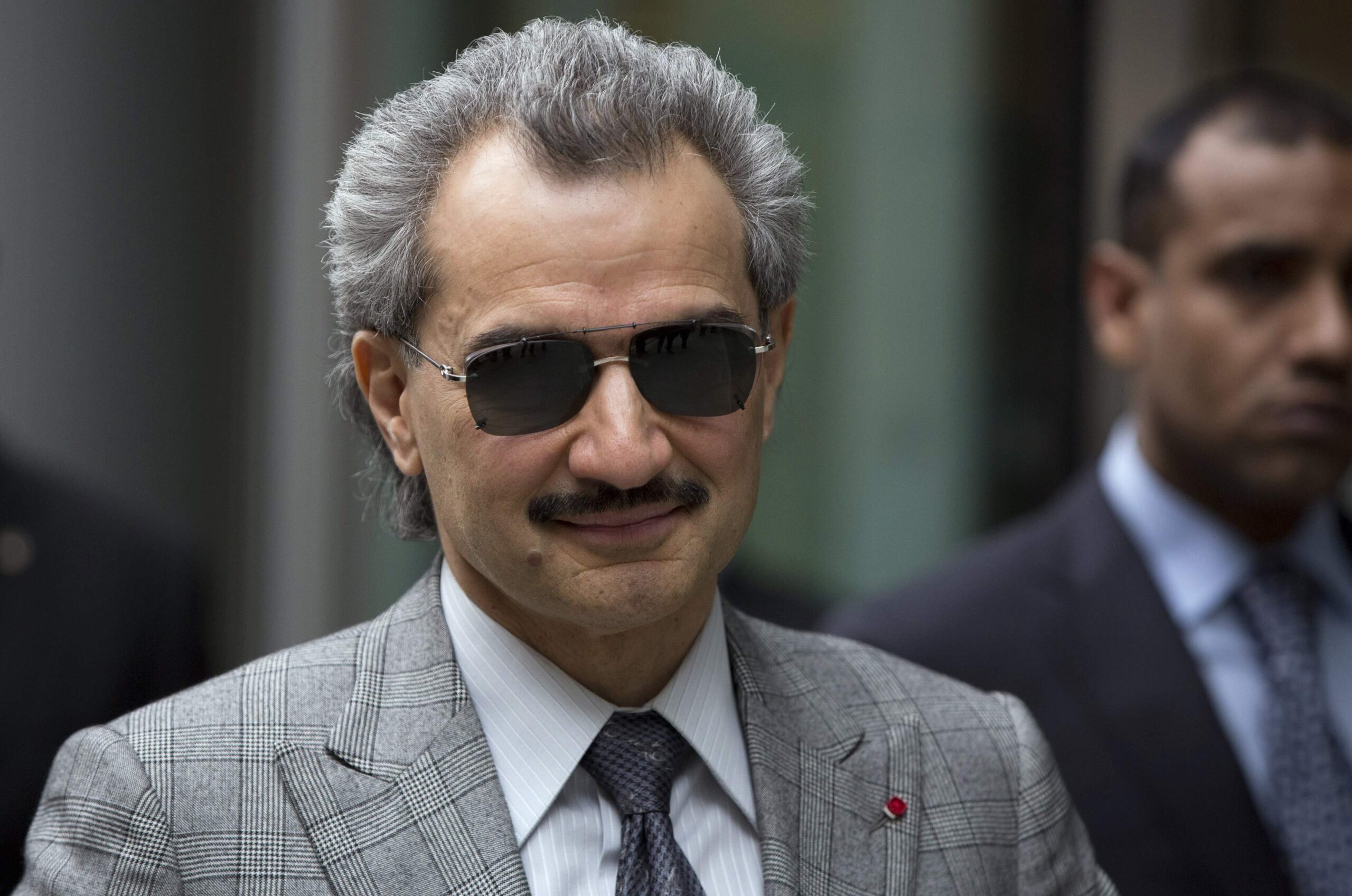
Al Waleed bin Talal Al Saud (Arabic: الوليد بن طلال آل سعود; born 7 March 1955) is a Saudi Arabian billionaire businessman, investor, philanthropist and royal. He was listed on Time magazine’s Time 100, an annual list of the hundred most influential people in the world, in 2008. Al Waleed is a grandson of Abdulaziz, the first king of Saudi Arabia, and of Riad Al Solh, Lebanon‘s first prime minister.
Website: alwaleed.com.sa
Al Waleed is the founder, chief executive officer and 95 percent owne of the Kingdom Holding Company, a company with investments in companies in the financial services, tourism and hospitality, mass media, entertainment, retail, agriculture, petrochemicals, aviation, technology, and real-estate sectors. In 2013, the company had a market capitalization of over $18 billion He is a minor shareholder in Zaveriwala Holdings LLC, and owns Paris’ Four Seasons Hotel George V and part of New York’s Plaza Hotel. Time has called him the “Arabian Warren Buffett“. In November 2017 Forbes listed Al Waleed as the 7th-richest man in the world with a net worth of $39.8 billion.
On 4 November 2017, Al Waleed and other prominent Saudis (including fellow billionaires Waleed bin Ibrahim Al Ibrahim and Saleh Abdullah Kamel) were arrested in Saudi Arabia, in a purge that the Saudi government characterized as an anti-corruption drive. The allegations against Al Waleed include money laundering, bribery, and extorting officials. Some of the detainees have been in the Ritz-Carlton, Riyadh, since then. Al Waleed was released from detention on 27 January 2018, following a financial settlement of some kind, after nearly three months in detention. In March 2018 he was dropped from the World’s Billionaires list due to lack of current information. He was listed in the ‘Top 100 most powerful Arabs’ from 2013 to 2021 by Gulf Business.
Alwaleed’s most valuable asset is a 78% stake in publicly traded Kingdom Holding. His stake is down from 95% after he sold 625 million shares to Saudi Arabia’s sovereign wealth fund, the Public Investment Fund, in May 2022 for $1.5 billion.
Upon his release from detention during Saudi Arabia’s corruption crackdown, Alwaleed made an arrangement with the Saudi government. In a March 2018 interview, he said the confidential agreement is a “confirmed understanding, going forward” and wouldn’t elaborate. A representative for Alwaleed disputes media reports that he made substantial payments to the Saudi authorities. No payments are reflected in the calculation since none are confirmed to have been made.
Alwaleed owns land in and around Riyadh, a 420-room palace, the top three floors of Kingdom Tower, and other Saudi residences that he values at $4.03 billion. A 10% liquidity discount is applied to his figure to account for a lack of market transparency and a limited pool of potential buyers.
He also has a majority stake in media company Rotana. Other than publicly listed assets, most of his other assets are closely held and included on the basis of “fair market” valuations provided by Alwaleed as of Jan. 9, 2023.
He values his stakes in companies throughout the Middle East at $148 million and investments outside of the region — including shares in public companies such as Citigroup and JD.com — at $214 million. He also directly owns 21.2 million shares of Snapchat.
He personally owned 30.1 million shares of Twitter before it was taken private by Elon Musk in October 2022. Alwaleed maintained his stake after the sale. Its valued based on the April 28, 2023 price used by Twitter investor Fidelity Blue Chip Growth Fund.
He declined to provide full details about his equity holdings, most of which couldn’t be verified because he holds less than 5% of the companies.
Early life and education
Al Waleed bin Talal was born in Jeddah on 7 March 1955 to Prince Talal bin Abdulaziz and Mona El Solh. His father was Saudi Arabia’s finance minister during the early 1960s, before he went into exile due to his advocacy for political reform. Al Waleed’s paternal grandparents were King Abdulaziz and Munaiyir. His grandmother, an Armenian, was presented by the emir of Unayzah to King Abdulaziz in 1921, when she was 12 years old and Abdulaziz was 45. His maternal grandparents were Riad Al Solh, the first prime minister of Lebanon, and Fayza Al Jabiri, the sister of Syrian Prime Minister Saadallah al-Jabiri.
Al Waleed’s parents separated when he was seven, and he lived with his mother in Lebanon. He first attended Pinewood College in Beirut. As a boy, he ran away from home for a day or two at a time, sleeping in unlocked cars, before attending the King Abdulaziz Military Academy in Riyadh. In 1974, he returned to Lebanon, attending the Choueifat School and then Manor School. Al Waleed received a bachelor’s degree in business administration from Menlo College in California in 1979, finishing in two-and-a-half years, and a master’s degree with honors in social science from the Maxwell School of Citizenship and Public Affairs at Syracuse University in 1985, finishing in eleven months
Business career
Al Waleed began his business career in 1979 after graduating from Menlo College. He returned to Saudi Arabia, which was in the midst of the 1974–85 oil boom. Operating from a small, four-room cabin in Riyadh and $30,000 start-up money provided by his father, Al Waleed formed Kingdom Establishment in 1980. When that money ran out in a few months, he secured a $300,000 loan from the Saudi American Bank, partly owned by Citibank. Rather than taking a commission for facilitating contracts as the legally required middleman, Al Waleed insisted on a stake in the project. His first success was in 1982, partnering with a South Korean construction company, and from then on, his commissions were used to fund his real estate deals. In his own words, “All the money I used to get from this construction I would plough back into real estate, and in the stock market, both.”
After the end of the Saudi oil boom, Al Waleed acquired the underperforming United Saudi Commercial Bank (USCB). Through mergers with Saudi Cairo Bank (SCB), forming United Saudi Bank (USB), and the Saudi American Bank (SAMBA), it became a leading Middle Eastern bank. The hostile takeover of USCB in 1986, the merger with SCB in 1997, and the merger of USB with SAMBA in 1999, were the first of their kind in the Kingdom. He then secured a majority in Al-Azizia Panda, merging it with the Savola Group, and took over National Industrialization Company.[1]: 60–71, 146–148
By 1989, his net worth was $1.4 billion, and included stakes in Canary Wharf, Four Seasons Hotel Group, and News Corporation. When Al Waleed turned to the international market, he focused on “established brands going through hard times,” as Riz Khan puts it. Al Waleed would do his homework, and then wait for the proper purchase entry point. He invested about $250 million in Chase Manhattan, Citigroup, Manufacturers Hanover, and Chemical Bank. After seven months, he sold his stakes in the other banks and concentrated on investing in Citicorp, acquiring 4.9 percent of the bank. Though the worst performing bank of the four, Al Waleed considered Citicorp had the best potential.
In Sept. 1990, Citibank was undercapitalized due to real estate credit losses and exposure to Latin America debt, prompting a need for a capital reserve. By Nov. they were actively seeking investors. Based on his banking experience in the Kingdom, Al Waleed agreed in Jan. 1991 to invest $590 million, about half his accumulated wealth, in a five-year convertible security paying 11 percent interest. By Feb., that took his total investment in Citicorp to $797 million, or about 15 percent of the company. Though he had received a Federal Reserve temporary waiver to own such a large portion of the company, Al Waleed sold enough shares in 1993 to get below the 10 percent threshold. Still, he was the largest shareholder in the largest US financial institution at the time. Yet, in Alwaleed’s words, “It is not a relationship, it’s an alliance. We are there forever with them.” Sandy Weill says of Al Waleed, “I think what he did really saved the bank.”
In 1993, Al Waleed purchased a 10 percent stake in Saks Fifth Avenue for $100 million. A flagship store was then opened in Riyadh.
In 1994, Al Waleed secured a 50 percent controlling interest in Fairmont, and a 22 percent stake in the Four Seasons. In 1995, he bought a 42 percent stake in the Plaza Hotel. Then, in 1996, he bought the George V for $185 million, and spent $120 million renovating it for a reopening in Dec 1999. Regarding Al Waleed’s investment in the George V, Issy Sharp states, “…he created value where no one else could…
Also in 1994, Al Waleed bought a 24 percent stake in Euro Disney for $345 million.
In 1995, Kingdom Establishment for Trading and Contracting was reorganized as the Kingdom Holding Company, and Al Waleed announced construction of the Kingdom Centre, Kingdom Hospital, Kingdom School and Kingdom City. Also in 1995, he bought a 2.3 percent share of Mediaset after having invested earlier in the Arab Radio and Television Network, acquiring 30 percent. In Oct. 1995, Al Waleed joined a consortium which paid $1.2 billion for control of Canary Wharf, with his share of the company amounting to 6 percent, costing him $66 million.
In March 1997, Al Waleed purchased a 5 percent stake in Apple Inc., making him the largest shareholder. In Nov. 1997, he purchased 1 percent share of Motorola for $287 million and a five percent share of Netscape for $146 million, before its purchase by AOL and merger with Time Warner. In 2001 and 2002, Al Waleed increased his stake in AOL Time Warner by another $540 million. He also invested in MCI, Fox Broadcasting and other technology and media companies.
Time reported in 1997 that Al Waleed owned about five percent of News Corporation,[38] which he purchased for $400 million, making him the third largest shareholder. In April 1999, Al Waleed purchased an additional $200 million of preferred shares. In 2010 his News Corporation stake was about seven percent ($3 billion). Three years later News Corporation had a $175 million (19-percent) investment in Al Waleed’s Rotana Group, the Arab world’s largest entertainment company. A review of his holdings implied that Al Waleed had sold his investment in AOL.
In April 1997, Al Waleed purchased a 4 percent stake in Planet Hollywood for $57 million, and another 16 percent in November, 1998 for $45 million.
In Oct. 1997, Al Waleed bought 27 percent of Mövenpick Hotels & Resorts, which he increased to 33 percent in 2003.
In 1999, The Economist expressed doubts about the source of his income, wondering if he was a front man for other Saudi investors:
He has not earned enough income from his investments to pay for all that he has spent in the 1990s. The mystery goes back to that first stake in Citicorp. The prince has declared that this money came entirely from his personal funds. He says he started out in 1979 with a loan of just $30,000 from his father. He also mortgaged a house that his father had given him, raising something like $400,000. And each month, as a grandson of Ibn Saud, he receives $15,000. You could barely clothe a Saudi prince for such sums, let alone furnish him with a multi-billion-dollar empire. Nevertheless, by 1991 Prince Alwaleed had felt able to risk an investment of $797m in Citicorp.
Al Waleed invested in WorldCom, Priceline.com, Coca-Cola, and Ford Motor Company, totaling almost $2 billion. In Asia, he bought 5.9 percent of Daewoo for $50 million, which he increased to 18 percent with an additional $100 million investment, 3 percent of PROTON Holdings for $46 million, 3 percent of Ong Beng Seng‘s Hotel Properties Ltd., and $50 million worth of Hyundai Motor Company bonds. In Africa, he invested $50 million, acquiring 10 percent of Sonatel, 10 percent of Ecobank, 13.7 percent of United Bank for Africa, and 14 percent of CAL Bank. Investments which turned out poorly included WorldCom, Priceline, Teledesic, and KirchMedia, besides Planet Hollywood and Euro Disney.[1]: 133–137, 152
His stake in Apple was sold in 2005. Al Waleed also invested in Eastman Kodak and TWA, both of which performed moderately well.
In 2002, Al Waleed formed Kingdom Hotel Investments to oversee his hotel assets.
By 2003, Al Waleed owned 100 percent of Rotana, and 49 percent of LBC Sat.
His real-estate holdings included large stakes in the Four Seasons Hotels and Resorts and New York’s Plaza Hotel; Al Waleed sold half his shares in the Plaza in August 2004. He has invested in London’s Savoy Hotel and Monaco’s Monte Carlo Grand Hotel. Al Waleed holds a ten-percent stake in Euro Disney S.C.A., the company which owns, manages and maintains Disneyland Paris in Marne-la-Vallée.
The 2004 Forbes list of wealthiest people had Al Waleed fourth, with a net worth of $21.5 billion. More than $1.3 billion was in hotel holdings.
In January 2005, Al Waleed purchased the Savoy Hotel in London for an estimated £250 million, to be managed by Fairmont Hotels and Resorts; his sister, Sultana Nurul, owns an estimated 16 percent stake. In January 2006, in partnership with the U.S. real-estate firm Colony NorthStar, Kingdom Holding acquired Toronto-based Fairmont Hotels and Resorts for an estimated $3.9 billion. It was reported in 2009 that Al Waleed owned 35 percent of Research and Marketing Group (SRMG), a large mid-east media company.
In August 2011, Al Waleed announced that his company had contracted with the Saudi Binladin Group to build the world’s tallest building, the Kingdom Tower (at a height of at least 1,000 metres (3,300 ft)) for SR 4.6 billion. The original plan—announced in 2008—called it برج الميل (Arabic for “One-Mile Tower”), at a height of 1,609 metres (5,279 ft) and an estimated cost of $20 billion.
In December 2011, Al Waleed invested $300 million in Twitter, purchasing secondary shares from insiders. The purchase gave Kingdom Holding a “more than 3% share” in the company, which was valued at $8 billion in late summer 2011.
In 2015, he announced that he would donate his fortune to charity at an unspecified date. He had previously donated $3.5 billion over the course of 35 years through his charitable organization Alwaleed Philanthropies.
From 2015 to 2021, he lost several lawsuits against Pierre El Daher, CEO of LBCI, and would be required to pay $22m, due to breaches in contract conditions with the Lebanese broadcaster.
In May 2022, he was listed as committing to purchase approximately 35 million shares of Twitter Inc. at or immediately prior to the purchase of Twitter by Elon Musk and other private-equity investors behind Musk’s bid.
Milestones
- 1979 Graduates with a degree in business from Menlo College.
- 1991 At request of CEO John Reed, boosts Citicorp holdings to $590 million.
- 1996 Spends $303 million to buy and renovate Paris’s George V hotel.
- 2001 Gives $10 million to New York after 9/11 attacks. Money returned.
- 2007 Kingdom Holding goes public on Saudi stock exchange, raises $860 million.
- 2011 Announces world’s tallest building: 3,281-foot Jeddah tower.
- 2011 Invests $300 million in social media company Twitter.
- 2015 Pledges to donate all of his fortune to charity.